This, however, is not a story about how these financial plans satisfy citizens, economists, or policymakers, but rather how the Union government and its fifty-plus ministries adhere to their own internal targets. On that count, the results are often underwhelming.
A Mint analysis comparing budgeted outlays with actual expenditure between FY10 and FY26, excluding the pandemic years of FY21 and FY22, shows that several ministries and flagship schemes faced sharp spending compression toward the end of the fiscal year. The squeeze intensified as the government walked a narrow fiscal tightrope, honouring its consolidation glide path while navigating post-pandemic economic fragility.
Wider and deeper
Front-loading allocations for key ministries at the beginning of the fiscal year is routine. So, too, is severe undershooting by the year-end.
Data available since 2009-10 shows that roughly a quarter of ministries (out of 53 listed by the government) have, on average, spent less than 80% of their budgeted allocations. The worrying part is thatthe trend has become wider and more severe in recent years. Between FY23 and FY25, 12-13% of ministries spent less than 50% of their allotted funds, compared with just 2-3% on average in the decade preceding the pandemic.
By FY25, nearly half used less than 80% of their allocations. FY26 revised estimates indicate some improvement, though these figures remain estimates. Actual expenditure numbers will only be known after the release of provisional numbers in May and final numbers in Budget 2027.
The Narendra Modi government, however, demonstrated stronger utilization ratios in the years preceding the pandemic, when only 10-16% of ministries undershot allocations by more than 20%.
The usual suspects
While spending cuts have become sharper, each year reveals a different set of ministries that lag against the budget aim.
Though there are some usual suspects that have lagged more often than not. These are the ministries that have spent less than 60% of their budgeted outlay in at least two of the last four fiscal years.
Most notably, minority affairs and tourism have consistently undershot their targets, with data points clustering well below the 60% threshold, indicating significant systemic bottlenecks in fund absorption, execution, or spending constraints.
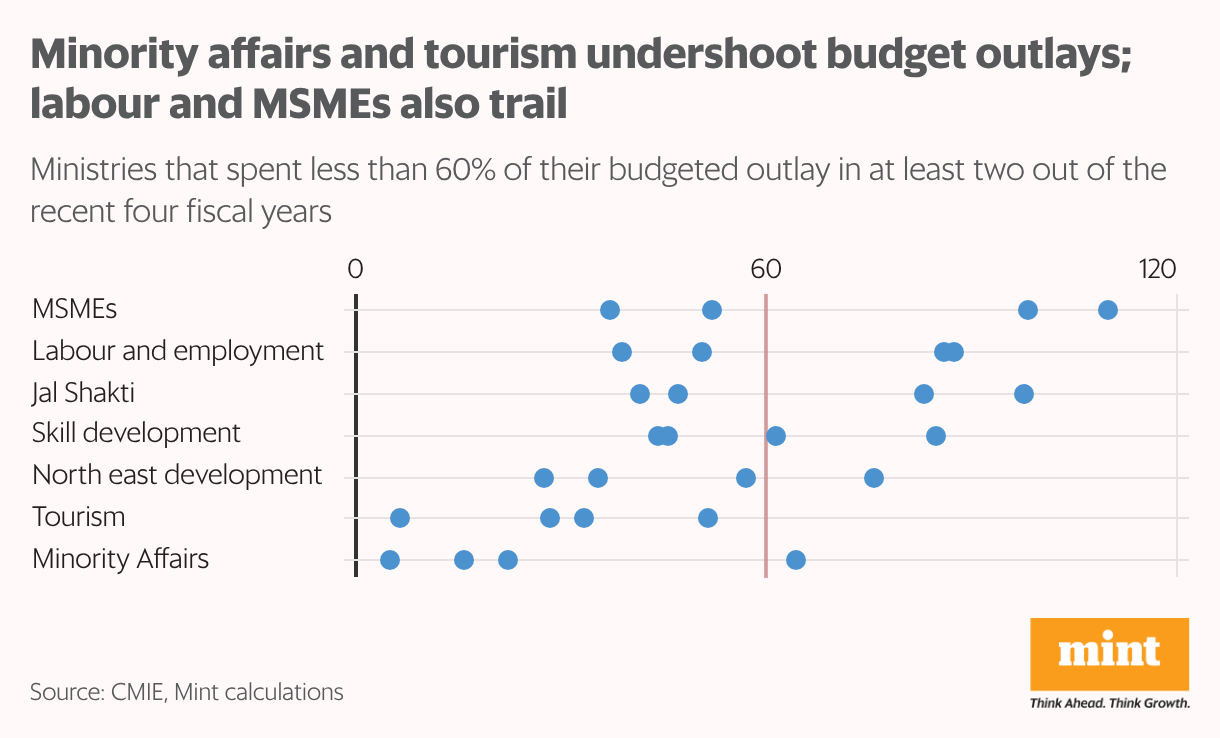
Ministries of labour and employment, and micro, small and medium enterprises also frequently miss spending targets by wide margins. Even ministries central to infrastructure and human capital, such as Jal Shakti and skill development, show erratic utilization, with multiple years of sharp undershooting.
The pattern suggests that while the Union budget lays out ambitious developmental priorities, execution has struggled to keep pace. Persistent underspending points to a persistent implementation gap that ultimately limits the scale and impact of national programmes.
Divided dividend
The performance of social sector ministries offers clues to the government’s welfare priorities.
An analysis of 10 of the 14 social sectors ministries and departments shows rural development (of which rural jobs scheme is the biggest component), and culture perform the best, spending more than their budgeted amounts on average, at 107.4% and 103.4%, respectively.
As such the rural jobs scheme (MNREGS), which is a demand driven scheme, has consistently spent more than what is allocated with the scheme seeing the highest overshooting of funds during the pandemic.
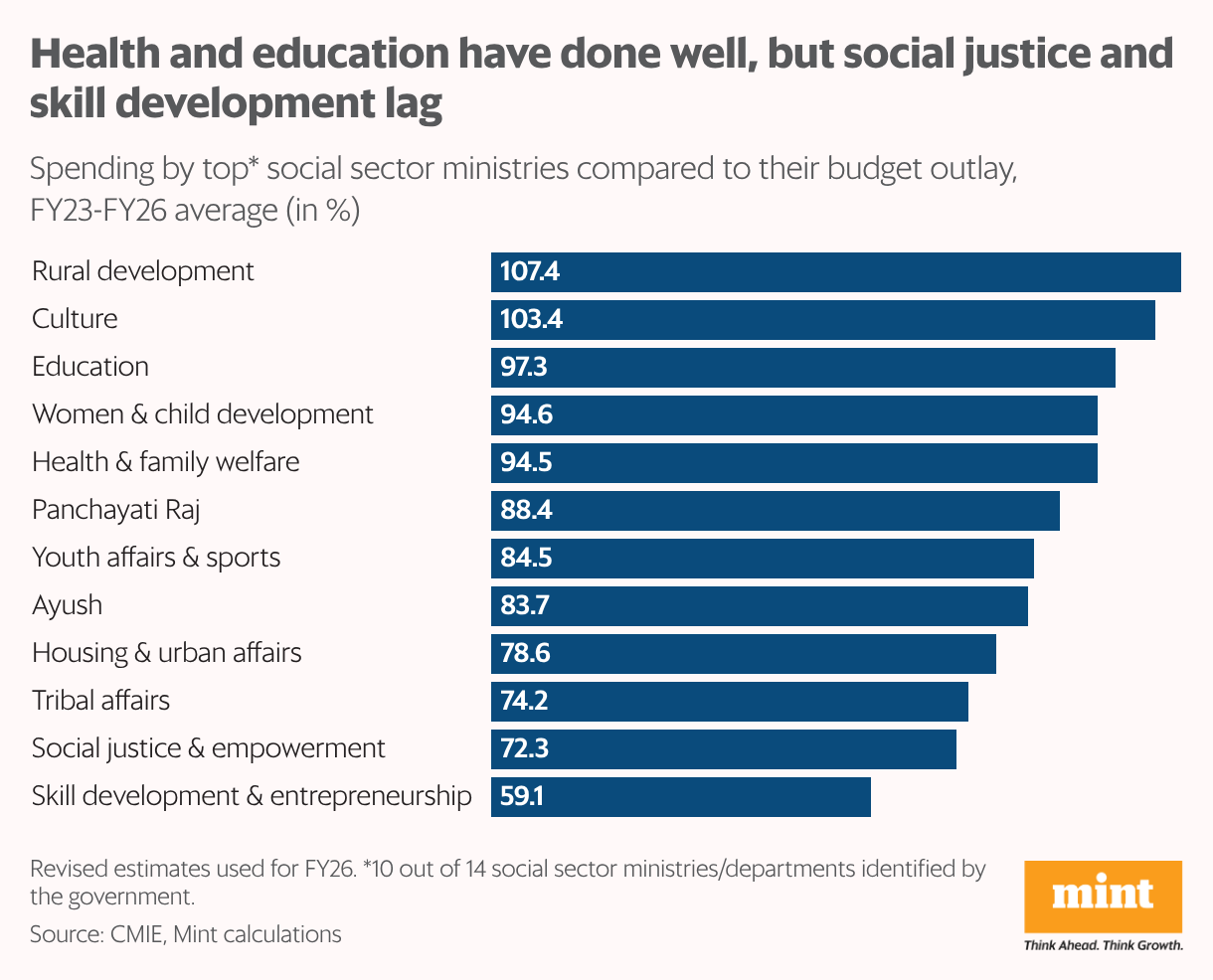
Health and education, the core pillars of social sector spending, have also fared well utilizing above 90% of the funds. While utilization may be good, this does not give the full picture as India’s broader spending on health and education remains well below desired levels.
Social sector ministries that have struggled to deploy funds include social justice and skilling. The skilling ministry has seen the lowest fund utilization in the category at 59.1% on average during FY23-FY26.
Scheme stagnation
The Modi government has opted to support growth through backing infrastructure-heavy programmes. Public delivery of goods and cash transfers has also been an important component of its governance model to make welfare programmes more ‘targeted’.
An analysis of the government’s 11 flagship schemes shows six of them have, on average, utilized less than 90% of their funds in the last four fiscal years (the post pandemic period). Jal Jeevan Mission—the scheme to provide tap water connection—utilized just 62% of its allocated funds on average during this period.
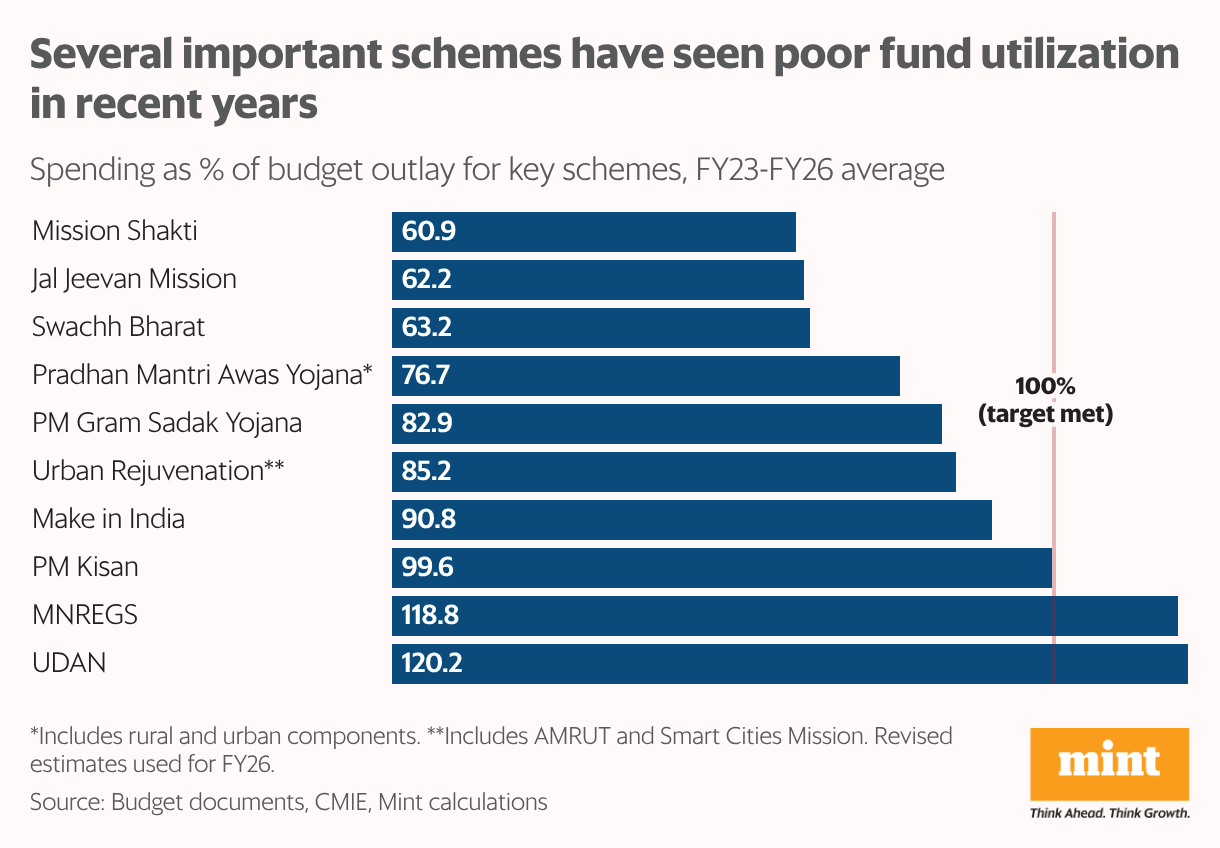
The figure stood at 63% for Swachh Bharat, while the government’s housing programme, PM Awas Yojana, saw 78% fund utilization.
One of the poorest performers is the government’s umbrella women empowerment scheme, Mission Shakti (61%). A shortfall in spending could indicate multiple things, such as scheme saturation, poor demand for the programme and over-optimistic budgeting. Schemes such as Jal Jeevan Mission, Swachh Bharat also saw front-loading in earlier years, which could reduce current year needs.
Fiscal squeeze
The government has received praise for rapid fiscal consolidation, taking the fiscal deficit from the pandemic-year high of 9.16% of GDP in FY21 to 4.31% of GDP by FY27. It also received flak and criticism for expenditure cuts, especially on the revenue account.
Data shows that a large part of the fiscal consolidation has come on the back of spending cuts, rather than an increase in revenue through tax and non-tax avenues.
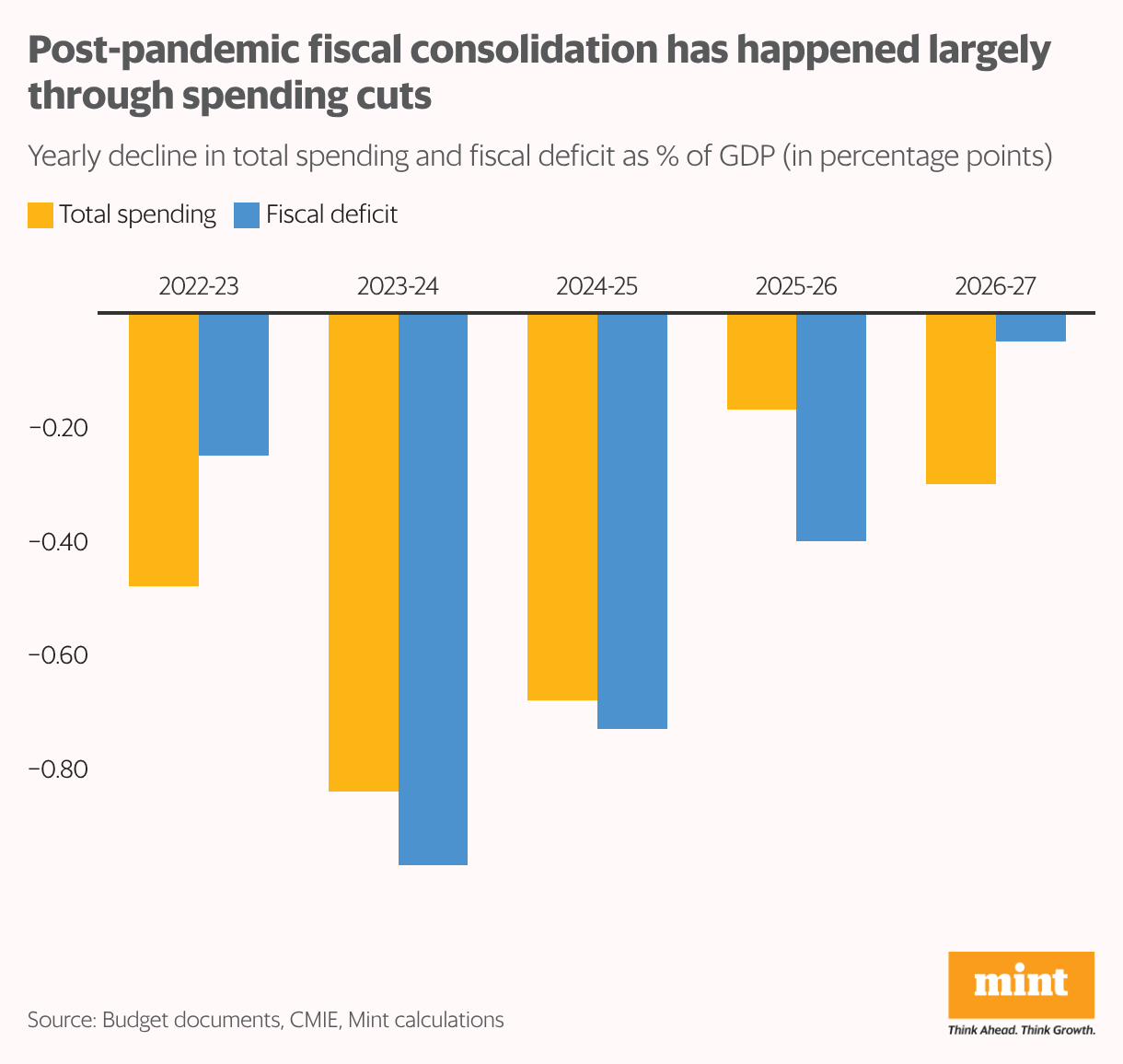
While fiscal discipline until FY26 earned praise, cuts in income tax and goods and services tax (GST) dried the revenue tap further in FY27, leading to a sharp expenditure cut of 30 basis points as a percentage of GDP, while the fiscal deficit is aimed to decline by just 5 basis points.
Moreover, since fiscal deficit tightening is being done largely through spending cuts towards the end of the year, as evident in previous sections, the question of whether the government should maintain its tight purse or pivot towards welfare is the defining debate for India amid global uncertainties threatening to dampen growth and sentiments.
Pragya Srivastava contributed to this story.