“I just about managed to recover the cost of cultivation,” Kajla said over phone. He is worried that the next winter crop of potato may be a washout, not because of inclement weather but due to plunging prices. Wholesale potato prices are hovering around ₹600 for a 50-kg bag, just about enough to cover the cost of cultivation, labour expenses for harvest, rental for cold stores and cost of transporting the produce to mandis (wholesale markets). Around this time last year, prices were nearly double.
“In two months, I will begin to harvest the potatoes. Fifty pairs of hands will work on my fields for over a month. Add to this the cost of transport and cold store rental. The daily expenses in the harvest season will be over ₹25,000,” Kajla said, adding, if prices drop further, his losses will mount. “And most likely prices will drop because of over planting by farmers across states.”
This is why Kajla stopped short of replacing his 12-year-old sedan with a new car. That just seemed like an extravagance after a dull harvest season. Instead, he spent a modest ₹90,000 on a harrow and a tiller, replacing some of his old farm machinery.
Like Kajla, 34-year-old Gaurva Mishra, a farmer from Sitapur in Uttar Pradesh postponed plans to renovate his house. Mishra’s rice crop was damaged and discoloured by the rains. The price he received, around ₹1,600 per quintal, was a far cry compared to the government-announced minimum support price (MSP) of ₹2,369 per quintal.
“It was a net loss for me. I had to purchase fertilizers in the black market (due to an acute shortage). I am not sure where wheat prices will be during harvest (in April next year). So, I am careful about expenses,” said Mishra who farms on 18 acres.
Lower incomes from the Kharif season and a dampened price outlook for the ongoing winter crop season is the reason why farmers like Kajla and Mishra say that the “sharp dip in prices have broken the farmers’ back.” That’s a warning for companies selling both fast-moving consumer goods (FMCG) like biscuits and hair oil as well as those selling durables like fridges and televisions.
More so, because sales growth of FMCG items in rural areas had outpaced that of urban ones for seven straight quarters, till September 2025. Rural markets, which account for 38% of FMCG sales, witnessed a 7.7% volume growth in the September quarter, lower than the 8.4% seen during the previous quarter, but higher than 3.7% growth in urban markets, as per the consumer intelligence platform NeilsonIQ.
Sales of two-wheelers and tractors, which have a large footprint in rural India, are expected to grow by 11% and 12% in November, as per domestic brokerage Motilal Oswal, buoyed by cuts in GST rates and the ongoing marriage season. Two-wheeler retail sales surged by 52% year-on-year in October but overall wholesale volumes at 11.9 million units, between April and October, were flat compared to the same year-ago period, as per ratings agency ICRA.
The mood on the ground, though not despondent, is contrary to the views offered by brokerages and market analysts who speak of “rural resilience” and growth in farm incomes on the back of a plentiful monsoon. But with a broad deflation at play, farmers are less exuberant.
It remains to be seen how the remainder of the year turns out.
Price trends
For now, the hit to farm incomes is evident in crop price trends.
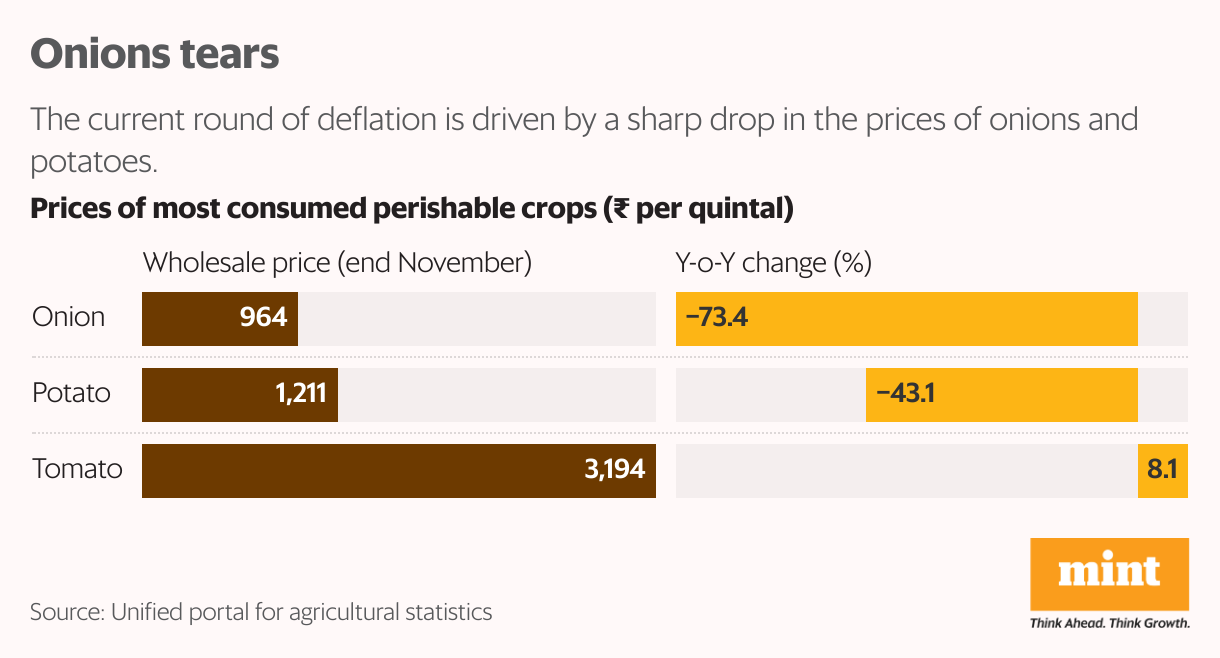
Take oilseeds, for example. As of end November, wholesale prices of oilseeds like groundnut and soybean were 20% lower than MSP. Soybean prices are lower by a fifth compared to what they were two years back. Similarly, wholesale prices of pulses like moong, tur and urad are 25%, 10% and 19% lower than MSP, respectively. Prices of most consumed vegetables like onions and potatoes are also on a slide too, lower by 73% and 43% respectively, year-on-year.
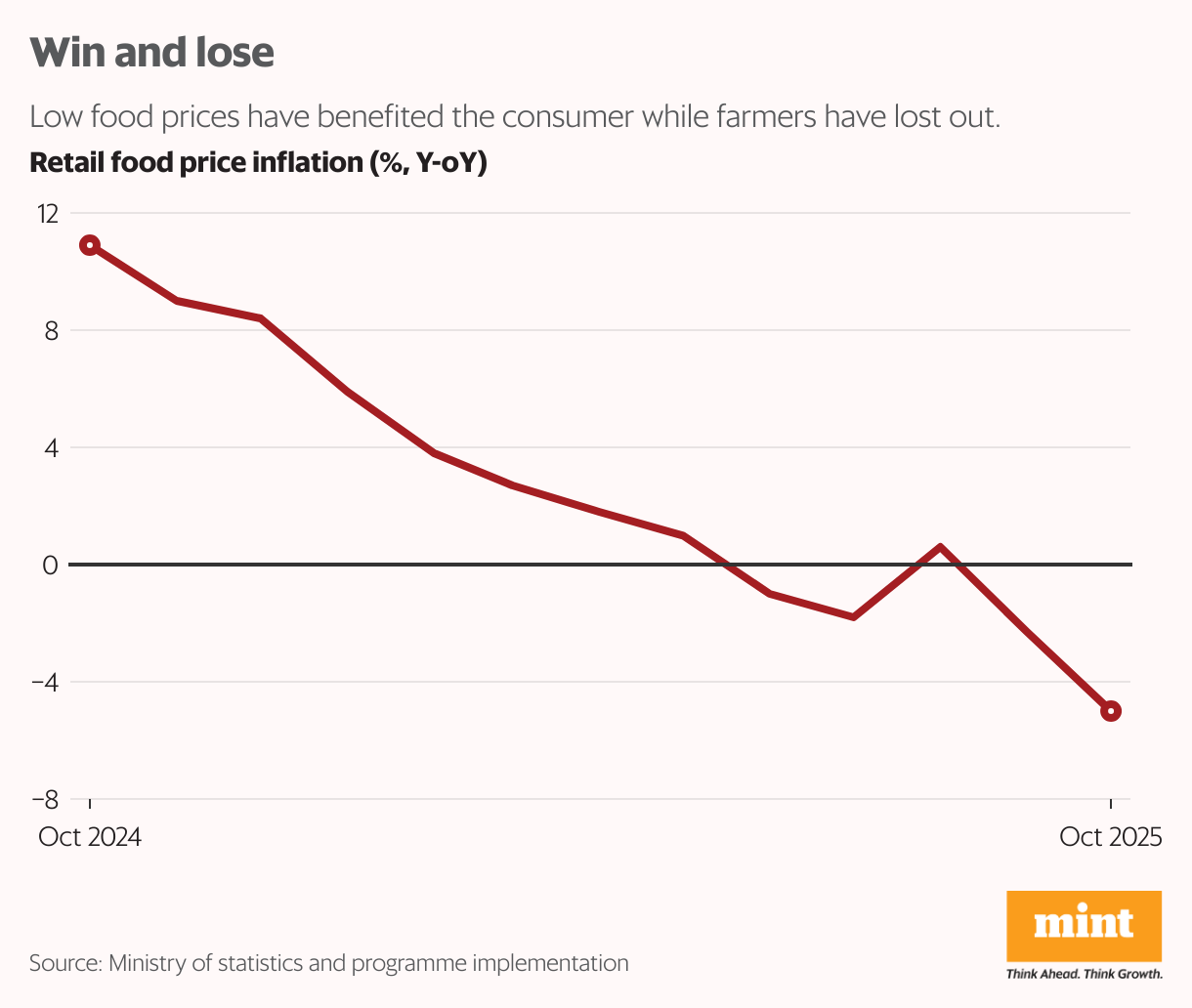
The deflation in wholesale crop prices pulled consumer inflation down to a record low of 0.25% in October (year on year). Food prices, which account for nearly 40% of the consumer basket, turned negative during the month, falling to -5% from -2.3% in September.
What the GDP tells
That the deflation in food prices has hurt rural incomes is evident from the latest GDP print.
As per the quarterly estimates of GDP for the second quarter (July-September), released on 28 November, real GDP grew by 8.2% in Q2. The farm sector grew by 3.5% year-on-year in real terms (adjusted for inflation), lower than the 4.1% growth last year. But in nominal terms (or at current prices), the farm sector grew by just 1.8% in Q2FY26—a sharp decline from 7.6% growth seen in the same year-ago quarter. This means that the agriculture sector, which contributes about 14% to GDP and employs nearly 46% of India’s workforce, is seeing incomes stagnate in nominal terms.
Past surveys (NABARD 2024) have shown that farm sources contribute about 45% of the earnings of agricultural households with the rest coming from wages, salaries and enterprise incomes (for instance, from running small shops). Stagnant farm incomes, therefore, could impact household level spending in rural areas.
While nominal farm incomes are stagnant, we need to note that the rural economy has other levers like direct cash transfer schemes which play a supporting role, said Dharmakirti Joshi, chief economist at Crisil. “Agricultural prices are often volatile and this round (of deflation) is driven by a sharp drop in prices of onions and potatoes. Overall, prices may revive soon but the good part is that crop production has been rising consistently over the past several years. At the same time, very low prices aren’t desirable for an economy, which is why the RBI (Reserve Bank of India) has an inflation tolerance band of 2-6%,” he added.
The deflation in prices is widespread and across commodities, said Himanshu, associate professor of economics at Jawaharlal Nehru University, Delhi. “It is not yet clear if low prices are a result of poor demand but ultimately it will impact farm incomes,” he held. “This could be the beginning of a crisis (which last occurred in 2017 and led to farm protests in different parts of India). Rural wages have been growing modestly in recent months but if farm revenue is stagnant, wages may be impacted in coming months,” Himanshu added.
Weather trouble
The just released crop production numbers show a subdued growth in output which is a result of uneven rains. As per the agriculture ministry’s first advance estimates of crop production for the Kharif season, food grain production rose by 2.3% year-on-year to 173 million tonnes in 2025-26. However, production of pulses at 7.4 million tonnes was lower than last year’s 7.7 million tonnes. Production of oilseed is also lower compared to last year (27.5 million tonnes in FY26 compared to 28 million tonnes in FY25). Production of cotton, among the major non-food crops, fell short of last year, too.
So, stagnant or lower production of some crops have been accompanied by a sharp decline in prices.
Farm incomes have been impacted by adverse weather, due to excess rains and floods in multiple states. The June to September southwest monsoon was above normal this year with rains at 108% of the 50-year average. Nearly half of India’s landmass experienced excess or extreme rains with multiple states reporting floods and landslides.

View Full Image
India faced extreme weather events on 99% of days in the first nine months of this year, marked by heat and cold waves, lightning and storms, heavy rain, floods and landslides, as per an assessment of extreme weather events by the Delhi-based Centre for Science and Environment. These events claimed 4,064 lives and impacted 9.5 million hectares of crop area, besides killing livestock and damaging property. The damage to crops would have climbed up following unseasonal showers in October just ahead of harvest.
Brutal harvest
For Deepak Pagar, an onion grower from Nashik in Maharashtra, the kharif harvest months of October and November have been brutal. Compared to production costs of ₹8-12 per kg (depending on plot-specific yield and weather), current wholesale prices are around ₹7 per kg.
“Past restrictions imposed on exports to keep domestic prices low for consumers have killed the export market. Onions are no longer being exported to countries like Bangladesh which were large buyers once. We have hit the streets several times in the past months but the government is yet to announce any support measures,” Pagar said.
He added that to grow onions in 20 acres, he ends up spending over ₹20 lakh in a season. Due to the crash in prices, he is unable to repay a debt of ₹10 lakh taken from finance companies (not banks) at high interest rates.
“I am even unable to pay the ₹30,000 college fees for my son who is studying in Pune,” he said. He added that farmers are in a bind as most crop prices have collapsed. “We may decide to plant less onions in the winter crop season. But then prices of other crops like soybean, maize and cotton are not any good. We are left with very little choice.”
Cotton yields are lower by 10-15% due to untimely rains in October but prices are lower than the MSP floor price after the government abolished the import duty, said Vijay Nawal, a farmer from Yavatmal district in Maharashtra.
Like cotton, where India has turned a net importer in recent years, India’s soaring imports of pulses and oilseeds at negligible duties impacted prices for domestic growers.
The centre removed the import duty in August, extending an olive branch to the US after it imposed 50% tariffs on exports from India (amid ongoing trade negotiations). The move was also meant to ease input costs for domestic mills. But as a result, farmers are receiving a price of around ₹6,800 per quintal, about 16% lower than the MSP of ₹8,110 per quintal. Prices are also low because of high moisture content in the fibre because of rains during harvest.
Like cotton, where India has turned a net importer in recent years, India’s soaring imports of pulses and oilseeds at negligible duties impacted prices for domestic growers. Nowhere is this more evident than in soybean where the current prices are more than 20% lower than MSP. Farmers from Madhya Pradesh, a large grower of soy, switched to maize in response. They hoped that high maize demand for conversion to ethanol, a biofuel blended with petrol, will ensure remunerative prices. But those hopes have been dashed.
Abhishek Raghuvanshi from Vidisha district of Madhya Pradesh planted corn for the first time in 2025 (overall kharif corn planting was 12% higher year-on-year). He expected an income of ₹4.5 lakh from 30 acre of corn crop, net of all costs. But part of his crop was damaged by rains and some was wolfed down by wild boars. “I could sell whatever was left for a pittance, at ₹935 per quintal,” he said. That’s more than 60% lower than the MSP for corn set at ₹2,400 per quintal. Traders are not paying more than ₹1,600 per quintal even for top quality corn, Raghuvanshi complained.
“There is a serious glut in wholesale markets. Even the marriage season has failed to firm up prices for chana and wheat (that are planted during the winter season). As a farmer, it is getting difficult to arrange the working capital for the next crop,” Raghuvanshi said. “Whatever big ticket items farmers are purchasing is because of easy loans. No one here is buying bikes or a car on cash.”
Key Takeaways
- Lower incomes from the Kharif season and a dampened price outlook for the ongoing winter crop season are worrying farmers
- The deflation in prices is across commodities
- That’s a warning for companies selling both fast moving consumer goods like biscuits and hair oil as well as those selling durables like fridges and televisions
- But, while nominal farm incomes are stagnant, the rural economy has other levers like direct cash transfer schemes which play a supporting role
- Crop prices may revive soon, too
- The mood on the ground, though not despondent, is contrary to the views offered by brokerages and market analysts who speak of “rural resilience”