India has been under sustained pressure from the US to scale back its purchases of Russian crude. US President Donald Trump has imposed an additional 25% tariff as a penalty for buying oil from Moscow, taking India’s total tariff burden to 50%. At the same time, New Delhi still lacks clarity on the long-discussed India-US trade agreement that could soften the blow of these duties.
Energy has become the main driver of the India-Russia partnership since 2022, with Russia emerging as India’s largest crude supplier. India’s imports surged on the back of steep Russian discounts, lifting Moscow’s share in India’s crude basket from less than 2% before 2022 to over 35%. But fresh US sanctions on Rosneft and Lukoil, Russia’s two largest oil companies, which took effect on 21 November have further complicated India’s position.
Even before the latest sanctions, India had begun reducing its dependence on Russian barrels as discounts narrowed sharply from their 2022 peaks. The new restrictions could accelerate that shift.
“We expect India’s imports of Russian crude to temporarily—but meaningfully—decline after 21 November. India has already been working to diversify its crude slate, and this process should accelerate, with higher purchases from the Middle East, the US, Latin America, and West Africa,” according to an analysis by Kpler, a real-time maritime and analytics provider, dated 25 November.
However, a complete halt is unlikely, it said, adding that the India will continue its imports through non-sanctioned Russian entities and “less transparent means”.
The surge in oil purchases has sharply widened India’s trade deficit with Russia, even as exports remain rangebound. Narrowing the gap by expanding export opportunities will be high on India’s agenda during Putin’s visit.
India’s imports from Russia have risen more than sixfold, touching $63.8 billion in FY25 compared with $10 million in FY22. Exports, meanwhile, reached $4.9 billion in FY25, up only slightly from $3.3 billion in FY22. This left India with a $59 billion trade deficit last fiscal year, with New Delhi repeatedly stressing that narrowing this gap must be a priority in bilateral discussions.
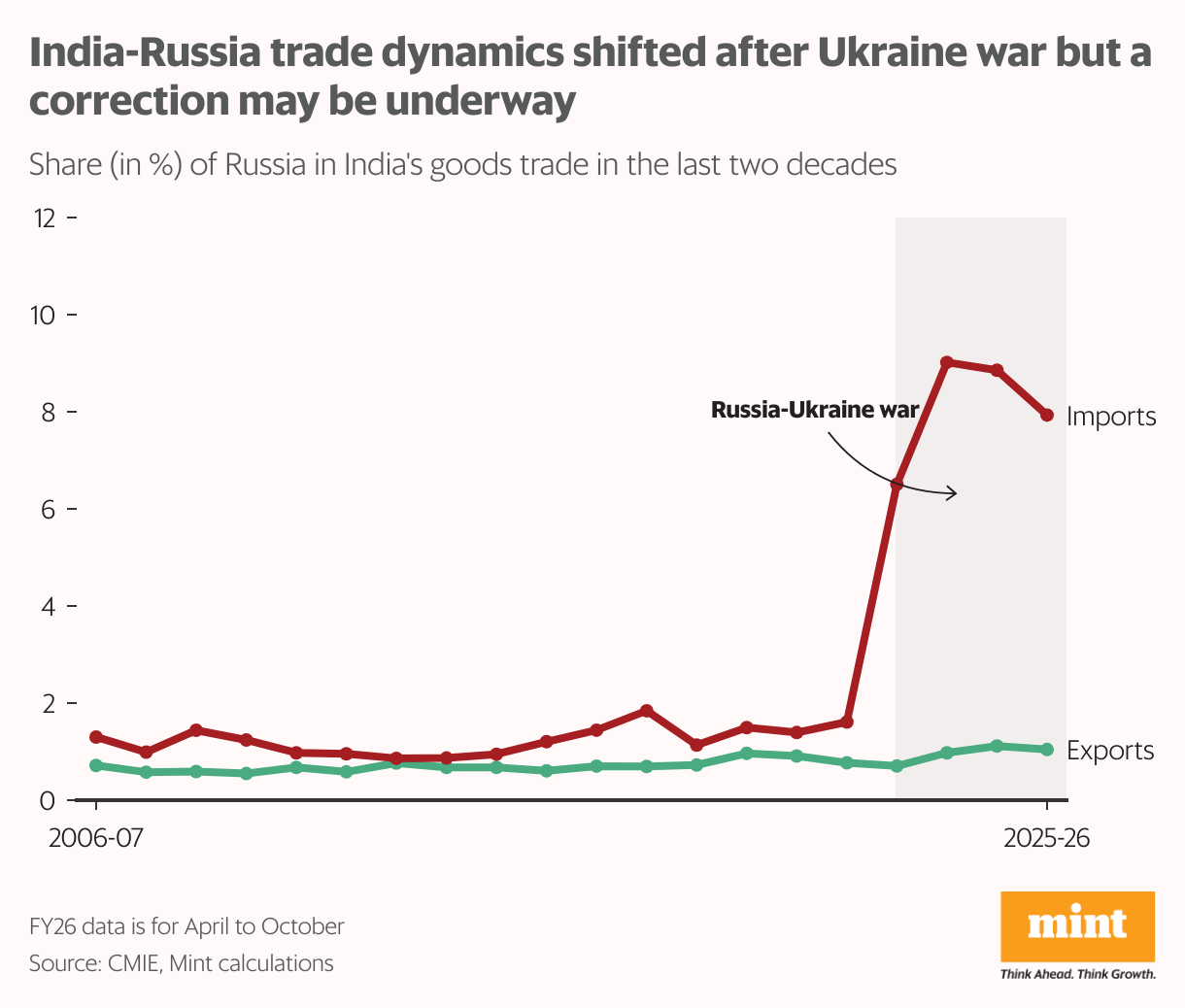
Petroleum products dominate India’s imports from Russia, accounting for 84% of the total in FY25. Other key commodities include coal/coke ($3.4 billion), vegetable oil ($2.5 billion) and fertilizers ($1.8 billion).
In contrast, India’s export basket remains limited to a narrow set of industrial and chemical items such as drugs and pharmaceuticals ($0.6 billion), machinery and instruments ($0.6 billion), and computer hardware ($0.5 billion).
“India relies on Russia for energy security and inputs, while struggling to scale value-added exports—leaving the bilateral trade equation lopsided and vulnerable to shocks in global commodity prices,” according to an analysis by Global Trade Research Initiative on 3 December.
Before energy became the central pillar, defence was the strongest link in the India-Russia partnership. India has long sourced major defence equipment from Russia, including missiles, air-defence systems and ships.
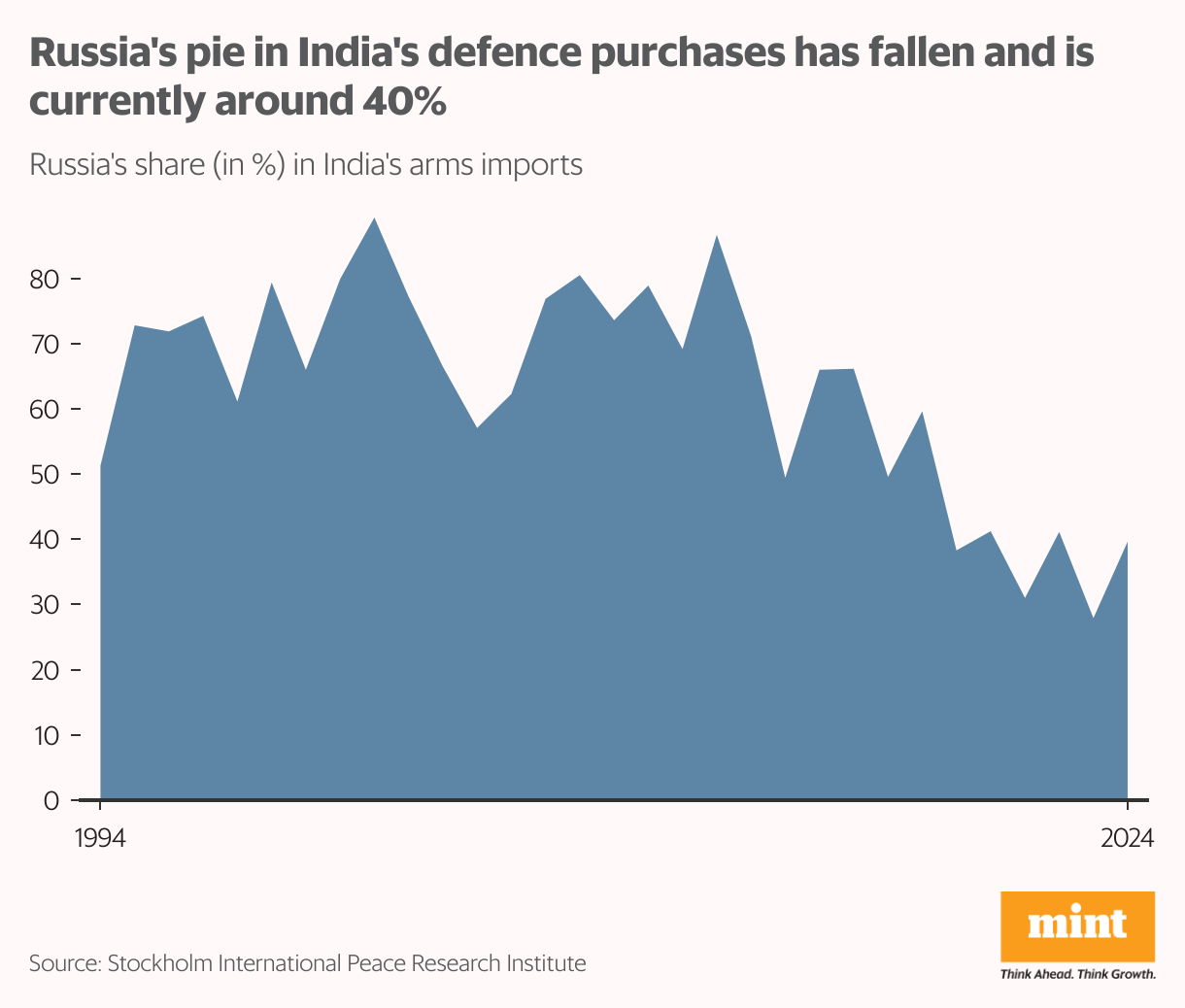
However, Russia’s share in India’s defence imports has fallen from nearly 90% at the start of the century to around 40% now. India has diversified procurement to countries such as France (14.2%) and Israel (26.5%), while the US share remains only 8.8% as of 2024, according to data from the Stockholm International Peace Research Institute (SIPRI).
Putin’s visit will see discussions on India’s potential purchase of additional units of the S-400 air defence missile systems and the Su-57 fifth-generation stealth fighter jet, Kremlin spokesperson Dmitry Peskov confirmed on Wednesday.
Indian labour migration has also begun reshaping bilateral ties. Russia is facing a severe worker shortage due to declining fertility rates and the diversion of labour to the Ukraine war. As the Russian government raised its quota for workers from visa-requiring countries from 156,600 in 2024 to 234,900 in 2025, South Asian nations, particularly India, Bangladesh, Nepal and Sri Lanka, have emerged as key labour sources, according to a June analysis by the Observer Research Foundation, a think tank.
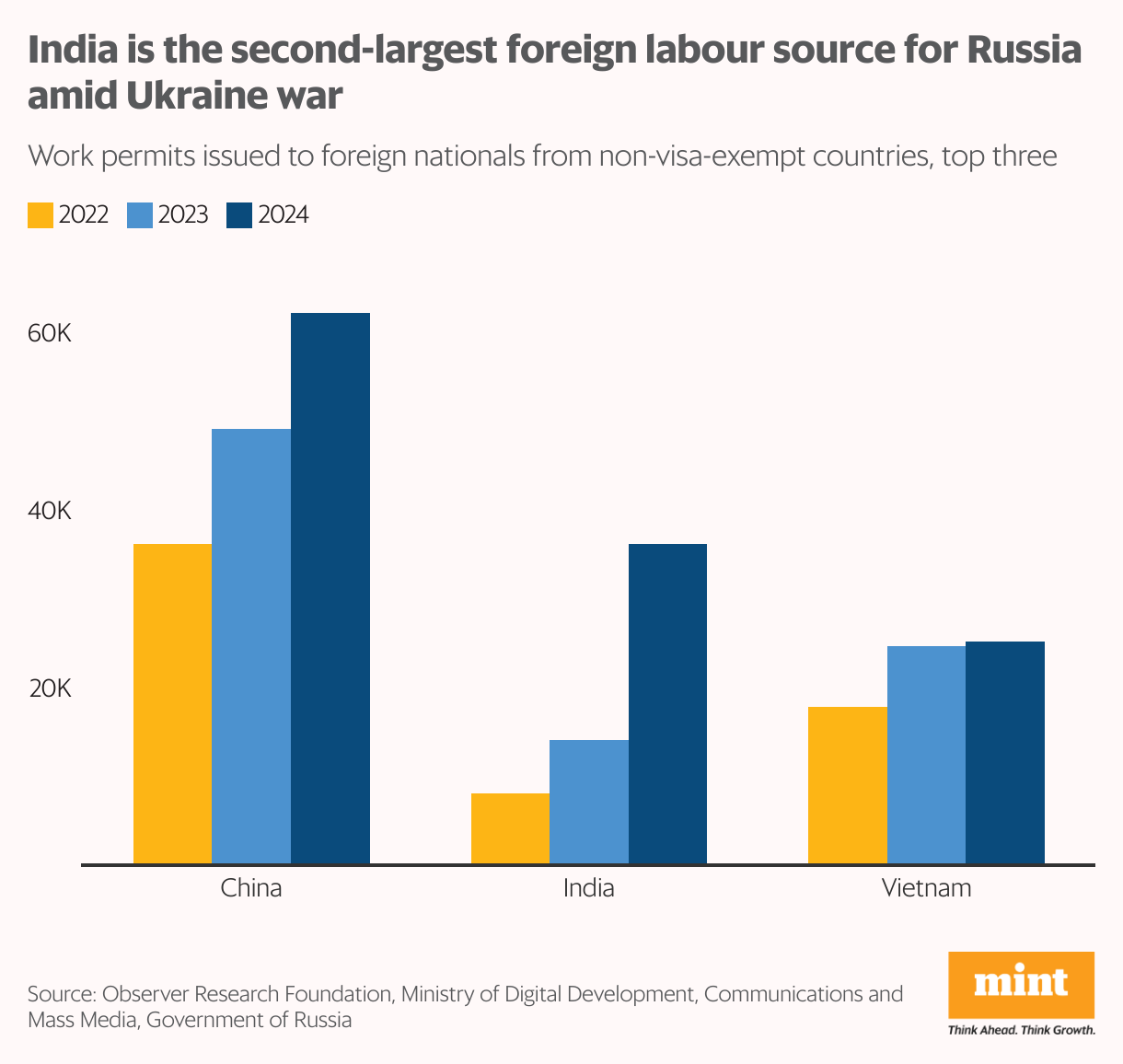
Indians are now the second-largest group among workers from non-visa-exempt countries, with work permits issued to them rising to 36,208 in 2024 from 5,480 in 2021, according to official data cited in the report. They are predominantly employed in construction, textiles, warehousing, and delivery.