Going into the inflation data released on Thursday, the hypothesis was: Our inflation measurement was highly outdated, and the monthly numbers we got—and, by extension, our monetary policy decisions—may not have been grounded in reality for some years.
But as it turns out, at face value, the major overhaul in the base year, consumption patterns, and methodology did not quite alter the country’s inflation story as we have known it in the last few years. Let’s break down the maths of it.
What changed on Thursday?
The statistics ministry released the inflation data for January 2026, the first with a base year of 2024, reporting retail inflation at 2.75%. But naturally, this is not comparable with the inflation data for previous months and years, which used the base year 2012. To enable like-to-like comparison, the ministry also released “back-series” data from 2013 to 2024. Inflation figures for different months using the same base year are theoretically comparable. But are they?
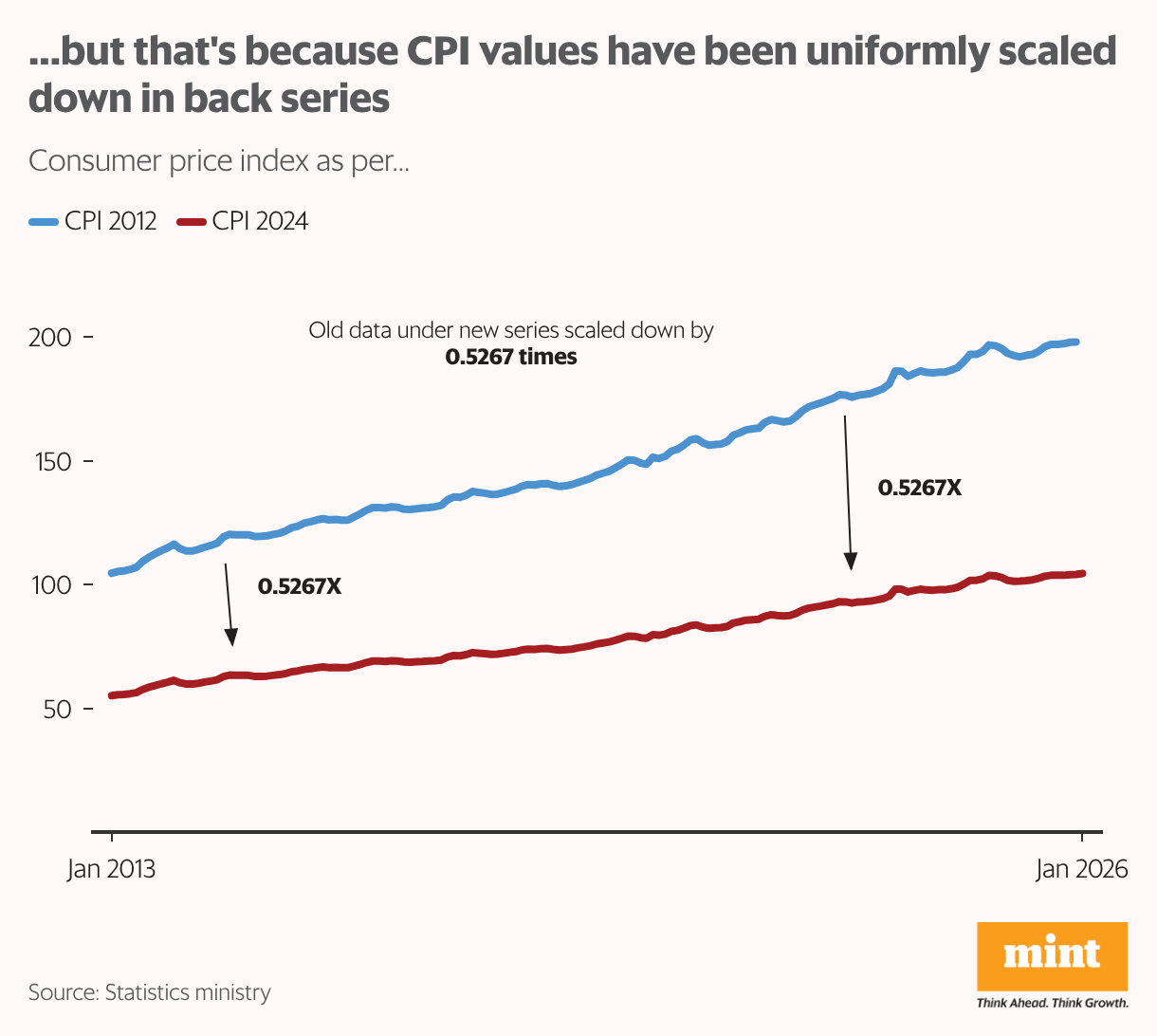
The back-series shows that inflation numbers for previous years have barely moved from what we knew them to be so far. In fact, the maximum difference in inflation rates between the old and the new series till 2024 is 16 basis points. For example, in July 2024, retail inflation stood at 3.6% according to the old series. Under the new series, it is nearly the same: 3.67%.
What does this say about old inflation figures?
The similarity is not unexpected, though. Technically, it’s not even possible to retrospectively have the same kind of data that the ministry now intends to use during its revised inflation computation. It’s incomparable from the outset: but then, the back series is not—and is not expected to be—a fundamental re-calculation of old prices using the new basket.
Instead, the back-calculated indices for 2013 to 2024 are merely a uniformly scaled version of the old 2012 index. The CPI value of 100 was earlier linked to 2012, which had nearly reached 200 by now due to annual inflation. These indices needed to be scaled back under the new year corresponding to CPI = 100, which is 2024. That’s all the ministry has done.
That means it’s purely a mathematical exercise to report the old inflation figures with a new base (i.e. where they stand as per the new base, not as per the new index’s methodology and basket). It’s not to make old data fundamentally “new” or comparable with the new index.
In that sense, the back-series is the best that was possible: not to make the data strictly comparable, but simply to apply the same base year to re-calibrate them based on the new CPI = 100.
How did the ministry do this?
The ministry used an overlapping year, 2025, for which the index was recorded under both series in accurate terms. Using the annual average in that year, it came up with a “linking factor” of 0.5267 to decide how much to scale the 2012-based CPI for each month in the past decade. Since each month’s index in previous years was merely scaled down, they didn’t see any relative change among each other, leading to only a marginal change in the year-on-year inflation rates.
For example, the 2012-based CPI for January 2021 was 156.3, which becomes 0.5267 times of it, i.e., 82.3 under the new series. The same figures for January 2022 were 165.7 and 87.3 (the same ratio of 0.5267 applied). Hence, the inflation rate in January 2022 was 6.01% in the old series and 6.08% in the new one.
It is for this reason that the ministry didn’t release back-series inflation figures for 2025: This was the only year without strictly comparable year-ago data.
What has changed in the inflation base year, and why was the adjustment necessary?
The CPI measurement has undergone a massive overhaul. The weight of food and beverages declined from 42.61% in the 2012 series to 36.75% in the 2024 series. The number of items went up from 299 to 358, six groups became 12 divisions, rural housing and new-age products such as online entertainment made an entry. Some obsolete items in the 2012 series that had become a source of worry—as well as amusement—such as VCR/VCD/DVD player, tape recorder, and CD/DVD audio/video cassettes, among others, are out of the inflation basket, years after they went out of our lives.
The reset in the CPI basket is a much-awaited development in the official statistics ecosystem. It reflects more recent consumption patterns among common people. It will therefore help policymakers guide policy more accurately, since retail inflation is the Reserve Bank of India’s main monetary policy anchor.
The base year revision in CPI should ideally be done every three to five years, according to global practices, to keep it up to date with the changing economy. That’s precisely the time period the ministry is now looking at, an official told Reuters earlier this week. However, the latest reset has come more than a decade later as the Household Consumer Expenditure Survey (HCES)—which forms the basis for the revamp—was junked for the 2017-18 edition due to “data quality issues”.
Work on resetting the inflation calculation gathered pace only after back-to-back HCEs were conducted in 2022-23 and 2023-24.