As the Milan-Cortina 2026 Winter Olympics approaches, new data by The Data Appeal Company and Mabrian, both part of Almawave Group, reveals accommodation rates across host destinations are set to more than double during the core days of the event, as an estimated 1 million visitors generate unprecedented pressure on local hospitality capacity.
Airlines Boost International Capacity to Milan and Venice Gateways
The data indicates Milan is primarily capturing international and long-haul demand, while Venice maintains equilibrium between domestic and European traffic flows.
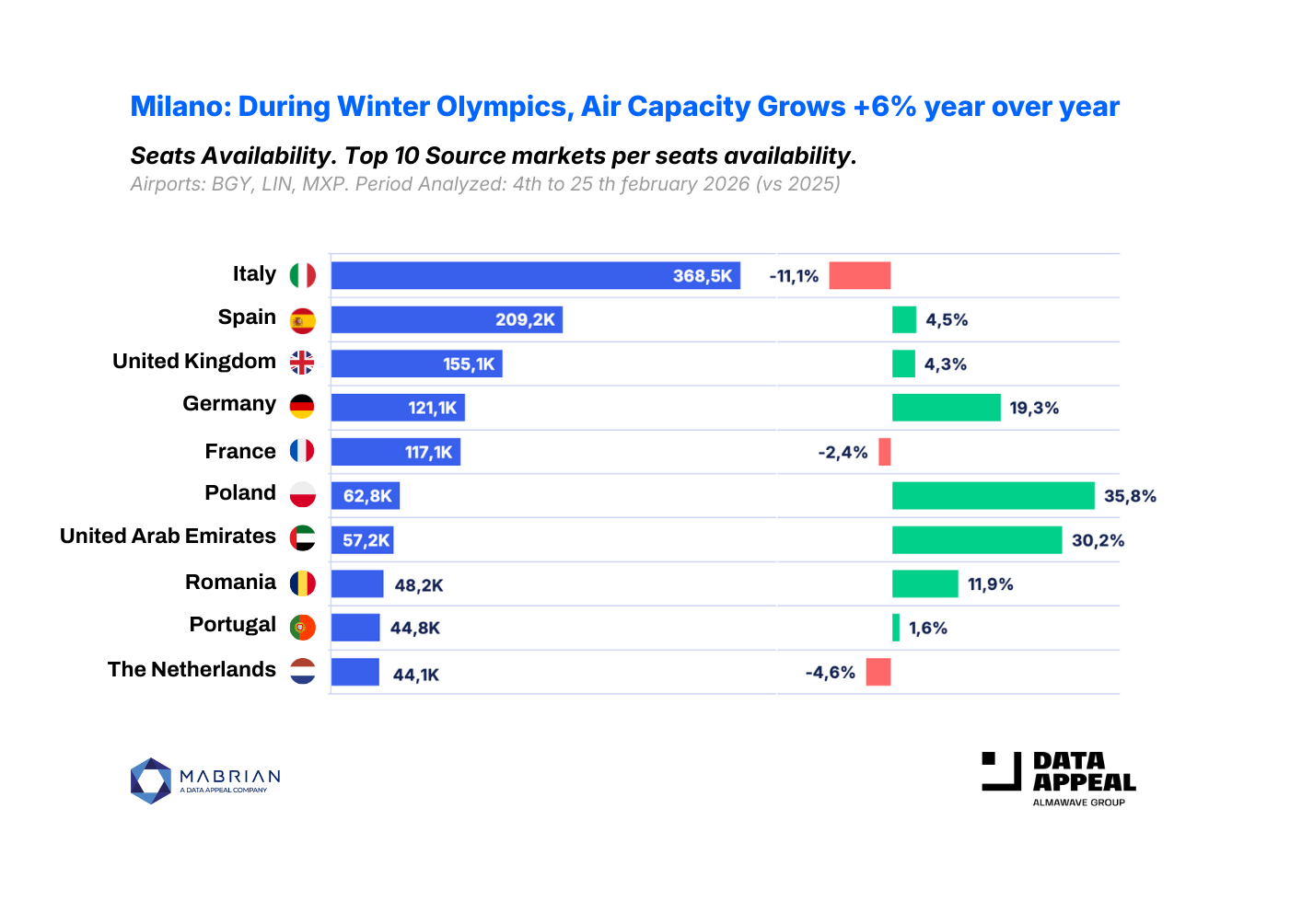
Flight capacity to Milan’s three airports (Malpensa, Linate, and Orio al Serio) is increasing 6% during the period of analysis (February 4-25 YoY), with international routes driving the expansion. Medium-haul capacity is up 13.7%, and long-haul routes are up 19.6%, reflecting strong global demand for the Games.
Key European markets demonstrate varied behaviour: Germany leads capacity growth at +19.3%, while France (-2.4%) and the Netherlands (-4.6%) have reduced seat availability alongside sharp fare increases of +45.5% and +34.3% respectively. Markets showing the most consistent growth are the UAE, with capacity up 30.2%, and Poland, up 35.8%. Both markets also saw fare reductions, indicating a competitive push to capture market share.
Venice’s Marco Polo Airport presents a more balanced growth profile at +5.6%, with international routes expanding 6% and domestic capacity up 3.9%.
“Understanding air capacity dynamics provides relevant and timely signs to a destination on how to effectively boost and cater to demand from well-connected inbound markets,” explains Carlos Cendra, Director of Marketing and Communications at Mabrian. “This analysis is crucial not only for sustained, year-round tourism growth but also for leveraging specific periods, such as major international events that have significant scope and global reach, such as the Winter Olympics.”
Accommodation Dominates Olympic Spending Profile
An estimated 1 million people are expected to attend the event, generating over €291 million in Predicted Event Spending (PES) across accommodation, dining, and transportation (direct tourist spending only). Accommodation accounts for 68% of total spending, reflecting the Olympics’ strong international appeal and extended-stay patterns. Dining accounts for 27%, while transportation to competition venues accounts for just 5%.
OTA Rates Soar as Peak Competition Intensifies Accommodation Demand
Online travel agency saturation levels across Olympic host cities in February have reached 40-55% during peak competition periods—up to 15 percentage points higher than in February 2025. It’s worth noting that OTAs represent only a portion of total bookings, as many properties prioritise direct channels during peak periods.
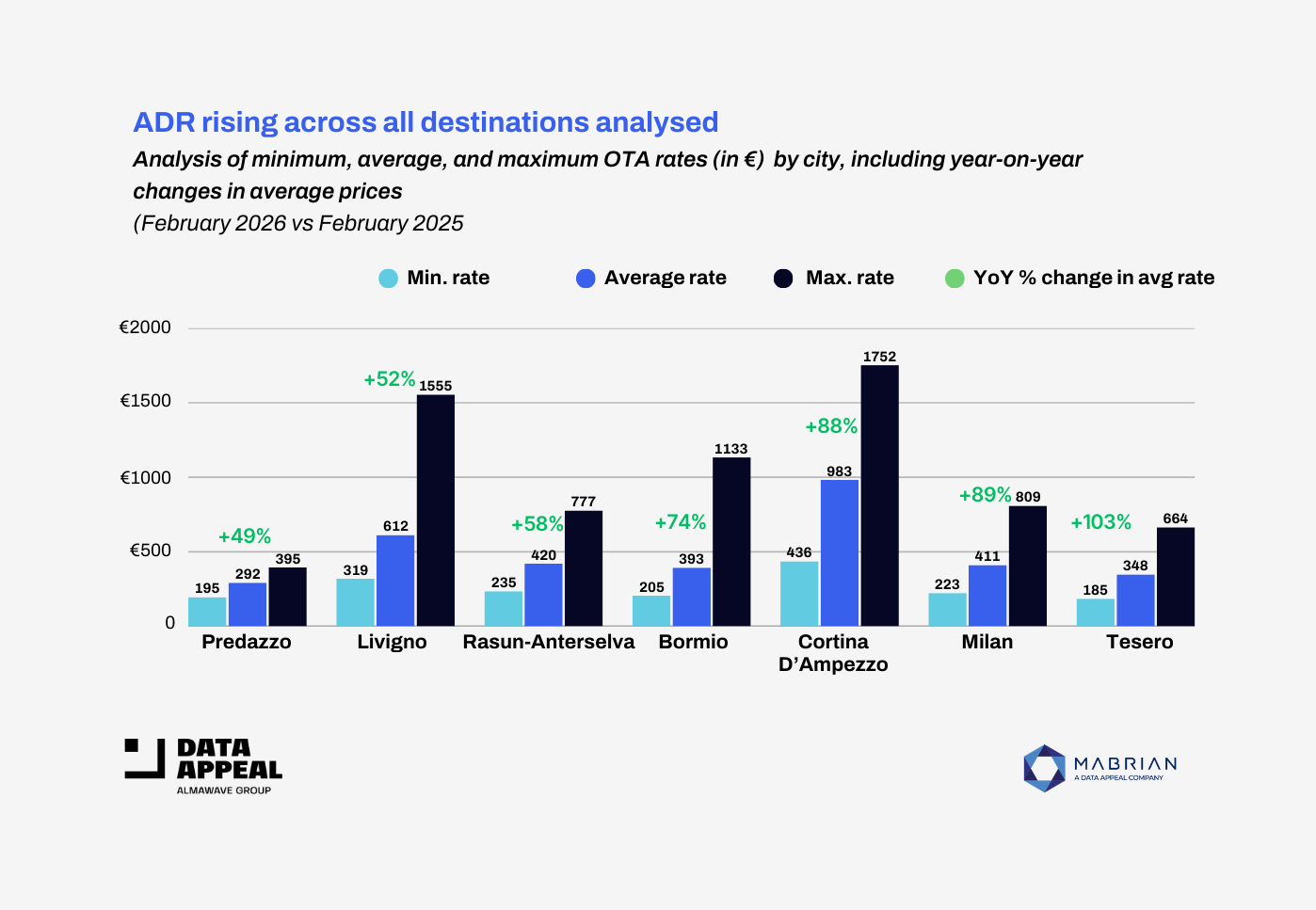
Cortina d’Ampezzo leads with average nightly rates of €983 (+88% year-over-year), with a maximum rate of €1,752. Livigno follows at €612 per night (+52% increase), while Tesero shows the steepest percentage increase at +103% despite maintaining among the most affordable rates among host cities.
The peak in rates occurs during the central period of the event, from February 10 to 17, 2026 which coincides with the most anticipated competitions, namely alpine skiing and snowboarding. The day with the sharpest increase compared to 2025 is February 13, when the average nightly rate more than doubled (+146%).
Ceremony dates also command significant premiums: Milan shows €412 average daily rates on February 6 (+119% year-over-year), while Verona registers €186 on February 21 (+51%)—the night before the event.
Four- and five-star properties currently report the highest occupancy rates, around 45%, with rate increases of +62% and +43%, respectively, and peak rates reaching €2,600 per night. This limited price sensitivity suggests that the event will attract predominantly high-spending visitors with a clear preference for upscale accommodation.
At the same time, the appeal of short-term rentals is also increasing, with ADR growth reaching +171% YoY. This indicates the presence of a broad segment of visitors who, despite having strong spending capacity, favor well-located and well-equipped apartments as an alternative to traditional hotels.
“Milano Cortina 2026 will put Italian tourism in the spotlight at the most critical time of year for many of these destinations.” explains Mirko Lalli, CEO & Founder of Data Appeal. “The combination of sporting appeal, winter seasonality, and international scale amplifies the Olympics’ impact on the entire tourism system, particularly the hospitality sector. Here, success won’t be determined by numbers alone, but by each destination’s ability to deliver a coherent, credible experience that lives up to the reputation it aims to build.”
Download the full report here: https://datappeal.io/free-report-milano-cortina-2026