While the GDP data issues are not new, what’s new is the rating system by the IMF—started last year—that has brought to public attention what experts have been saying for close to a decade.
A ‘C’ rating means India’s GDP data has “some shortcomings that somewhat hamper surveillance”.
To begin with, the fundamental issue is the use of a base year from over a decade ago, specifically 2011-12. Besides that, opacity in the use of deflators to calculate growth after stripping the effect of inflation, huge mismatches in estimates between the production and expenditure approaches, and inadequate coverage of the informal sector are some other issues.
These have made India and China only two prominent countries in the world that have high-growth track records, but with inadequate or suspect data. Even the up-and-coming Vietnam, which has a poor overall statistical record, scored an ‘A’ on GDP data quality.
Latest impact
The issues highlighted by the IMF have long plagued the GDP numbers, leading to official growth numbers sometimes out of sync with broader expectations.
This also played out in the last quarter, making 8.2% growth in Q2 a less reliable indicator of underlying economic activity
Many economists shed light on the 8.7% growth in nominal GDP, down from 8.8% in the April-June quarter and 10.8% in the January-March quarter. The main identifiable culprits behind real GDP growth surging despite slowing nominal GDP were deflator issues and high discrepancies in data.
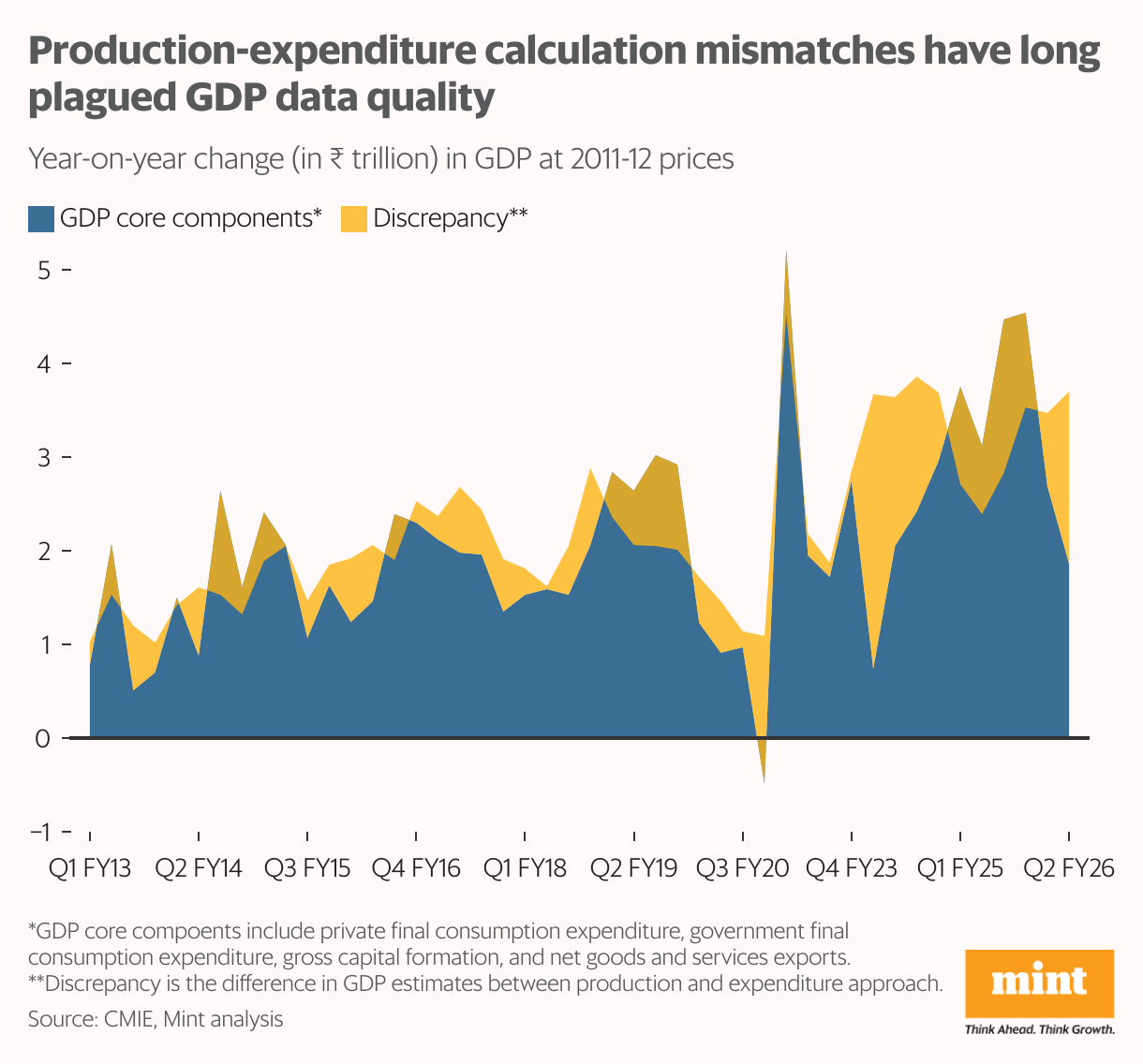
First of all, discrepancy—the gap in estimates between production and expenditure—was extremely high, particularly in Q2. Of the ₹3.7 trillion increase in GDP at constant prices from the production side, ₹1.84 trillion was discrepancies.
This means the ministry was unable to assign roughly half of the economic momentum under proper expenditure heads—consumption, investment or trade. Strip this off, and growth momentum comes down to just 4.1%. It means that either the estimates were overestimated in the production approach or underestimated in the expenditure approach.
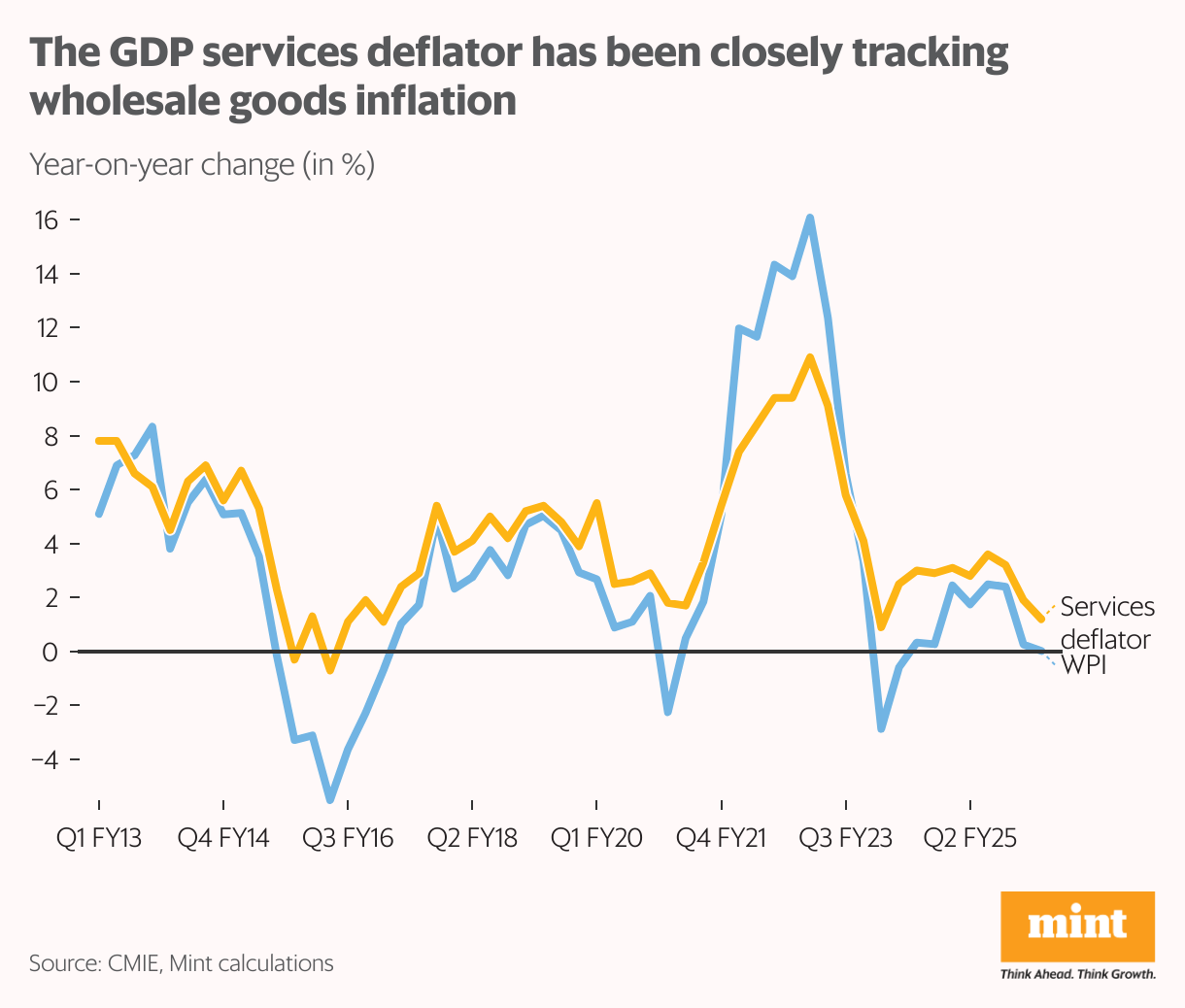
An overestimation is likely, as wholesale inflation, which was just 0.02% in Q2, is excessively used to deflate economic activity from current prices to inflation-adjusted prices.
While WPI is primarily goods inflation, it is being used for several service sector components, possibly resulting in high real growth, not primarily because of low inflation, but because of an inappropriate method of inflation adjustment.
“The dependence of the statistics office on some wholesale measure of inflation centred towards the goods side to deflate the services sector may also be exaggerating growth,” ICICI Primary Dealership said in a report.
The problem arises because India has been using a single deflation method, that is, a single measure to adjust prices, instead of a globally acceptable double deflation method using separate measures for input and output prices. This leads to misleading results, especially when input prices diverge significantly from output prices, which was the case for several sectors in Q2.
The way forward…
The issues highlighted by the IMF are well-known, have been raised by several experts, including former chief economic advisor Arvind Subramanian, over the years, and acknowledged by the ministry of statistics and programme implementation.
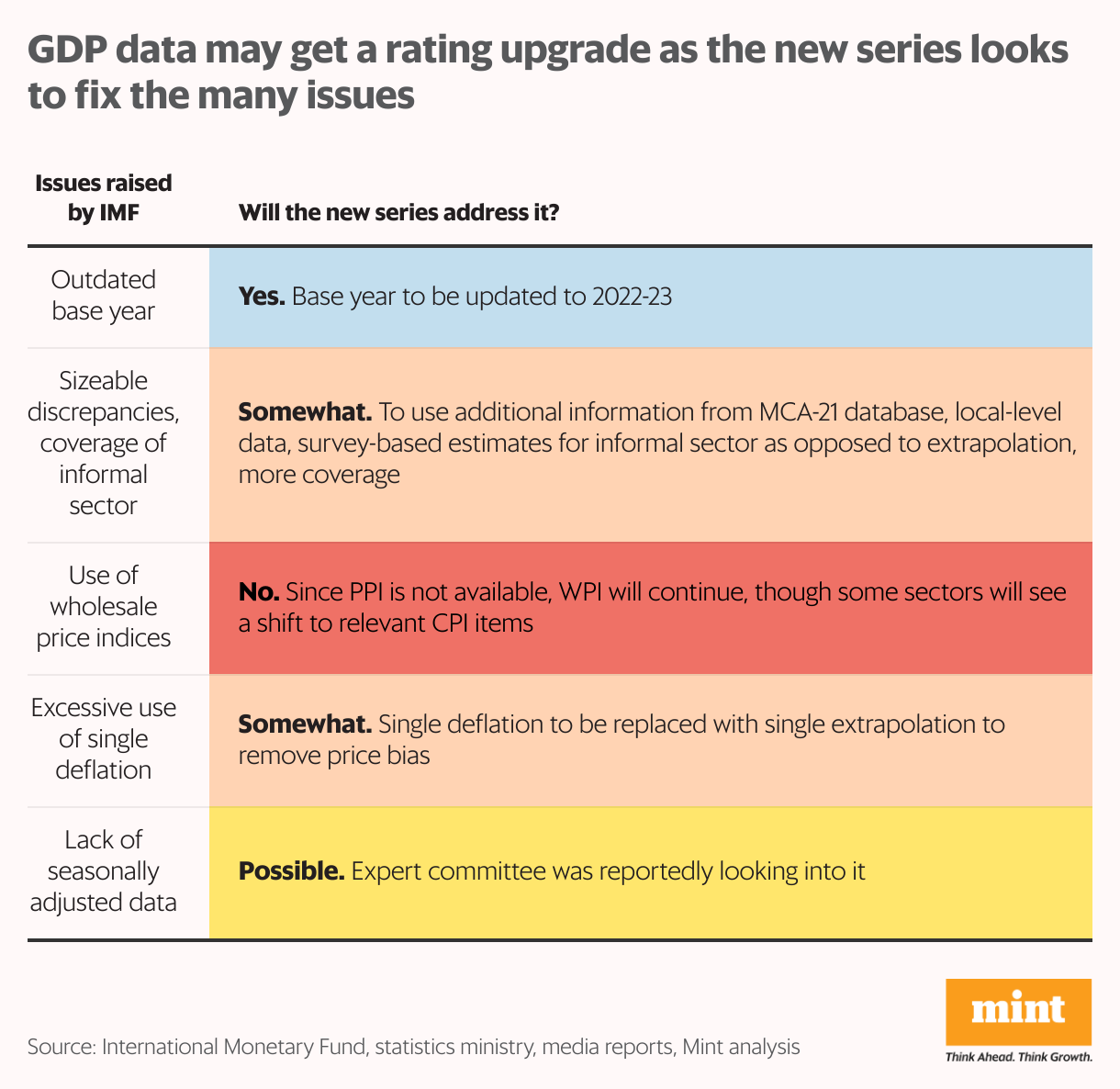
The hope is that the long-overdue updation in the base years for GDP, inflation and industrial production will help capture economic activity better and may even lead to an upgrade in the IMF rating. The ministry is planning for the new series by the end of February 2026.
“I am sure when the IMF comes back next year around this time, you would see better comments on statistics,” said N.R. Bhanumurthy, director of Madras School of Economics.
While the launch of a new series, after a gap of 10 years, is expected to address several data issues, a few, like the usage of double deflation and Producer Price Index (which takes into account services as well) may remain unaddressed.
A Mint analysis of a discussion paper on the new GDP series shows a major overhaul that will take into account new and more information from the MCA-21 database, look to address any overestimation in company data, and make use of regular survey data on the informal sector as opposed to extrapolation of estimates from different indicators, among other things.
However, the discussion paper said it will continue to use a single deflation method for several sectors, but make statistical tweaks to minimise discrepancies, such as shifting to CPI items for deflating some services segments.
The IMF’s recommendation to use the Producer Price Index (PPI) is unlikely to take place, as India, despite several attempts made in the past, has not yet formulated the index.
“We haven’t been able to get the data as producers have absolutely resisted giving data on the producer prices,” said Pronab Sen, former chief statistician of India.
Despite the much-awaited upgrade in the series, the changes may not stay good for long. The upcoming base will precede census estimates, which are also delayed by at least 15 years. Once the census is done and new demographic numbers are in, another revision in the GDP base year will capture economic momentum even better.
“I expect a revision in another 3-4 years again as soon as the census is over to replace population projection with actual population figures,” said P.C. Mohanan, former acting chairperson of the National Statistical Commission (NSC).
While India has largely impressed the world with its growth momentum, data issues leave a question mark over its track record.
The country cannot afford to be in the same club as China, which is infamous for suspect or unreliable data.
The upcoming revision will address several questions, but the country should strive not to allow such long gaps in statistical improvements.
(Payal Bhattacharya contributed to the story.)