Following months of tariff disputes and prolonged negotiations that tested the India–US relations, a long-awaited free trade agreement was announced on Monday.
India announced that it would face 18% reciprocal US tariffs, down from 50%. The US, meanwhile, said India had agreed to stop buying Russian oil, move toward zero tariffs on a wide range of American products and eliminate non-tariff barriers, buy $500 billion of US products, and allow greater access to its farm sector.
However, it has reiterated that it will protect sensitive sectors like farm and dairy. Nevertheless, an 18% tariff puts India on a level playing field with other export competitors, if not at an advantage.
Internship outlay cut
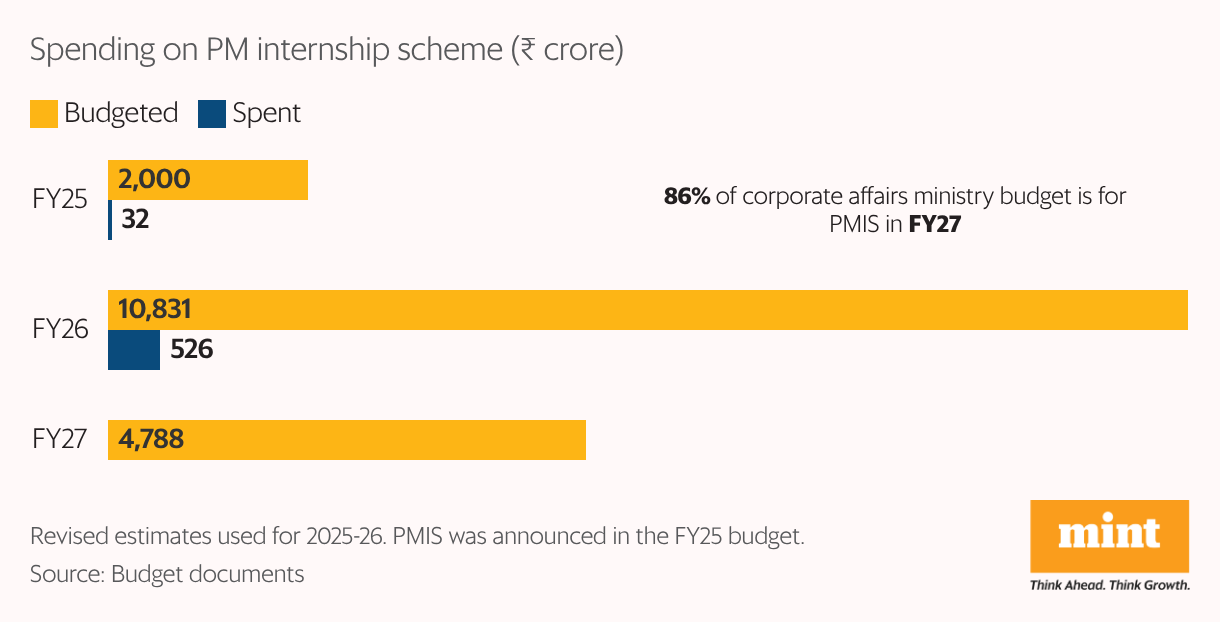
The Union Budget 2026-27, which was presented by finance minister Nirmala Sitharaman on 1 February, slashed the allocation for the Prime Minister’s Internship Scheme (PMIS) to about ₹4,788 crore from the previous year’s budget allocation of over ₹10,831 crore.
One of the Modi government’s flagship schemes, the PMIS, has struggled to utilise its allocated funds effectively. The PMIS utilised only 1.6% of its allocation in FY25, the year it was launched, and is estimated to exhaust only 5% of the budgeted outlay in FY26.
The lack of demand for funds under the scheme is concerning, especially in the context of the high unemployment rate of 10.2% in FY24 among the youth population, compared with the national average of 3.2%.
Numbers Talk
₹2,229 crore: The consolidated net profit reported by Bajaj Finserv for Q3 FY26, marginally down from last year, due to labour code compliance and accelerated expected credit loss despite a 24% rise in revenue.
96%: The share of surveyed WhatsApp users who receive unsolicited or spam messages daily, with 30% reporting four to seven such texts every day, according to a recent survey conducted by LocalCircles
₹5 lakh: The proposed minimum fine with seven years prison term under the Drugs and Cosmetics Act as India’s drug regulator moves to curb the illegal diversion of pharmaceutical opioids amid a worsening opioid crisis.
236,963: The total number of vehicles sold by Maruti Suzuki India in January, up 12% from 212,251 units in the same period last year.
$1 billion: The amount in damages US President Donald Trump is seeking from Harvard University, escalating a confrontation over alleged ideological bias and campus protests.
Services prevail
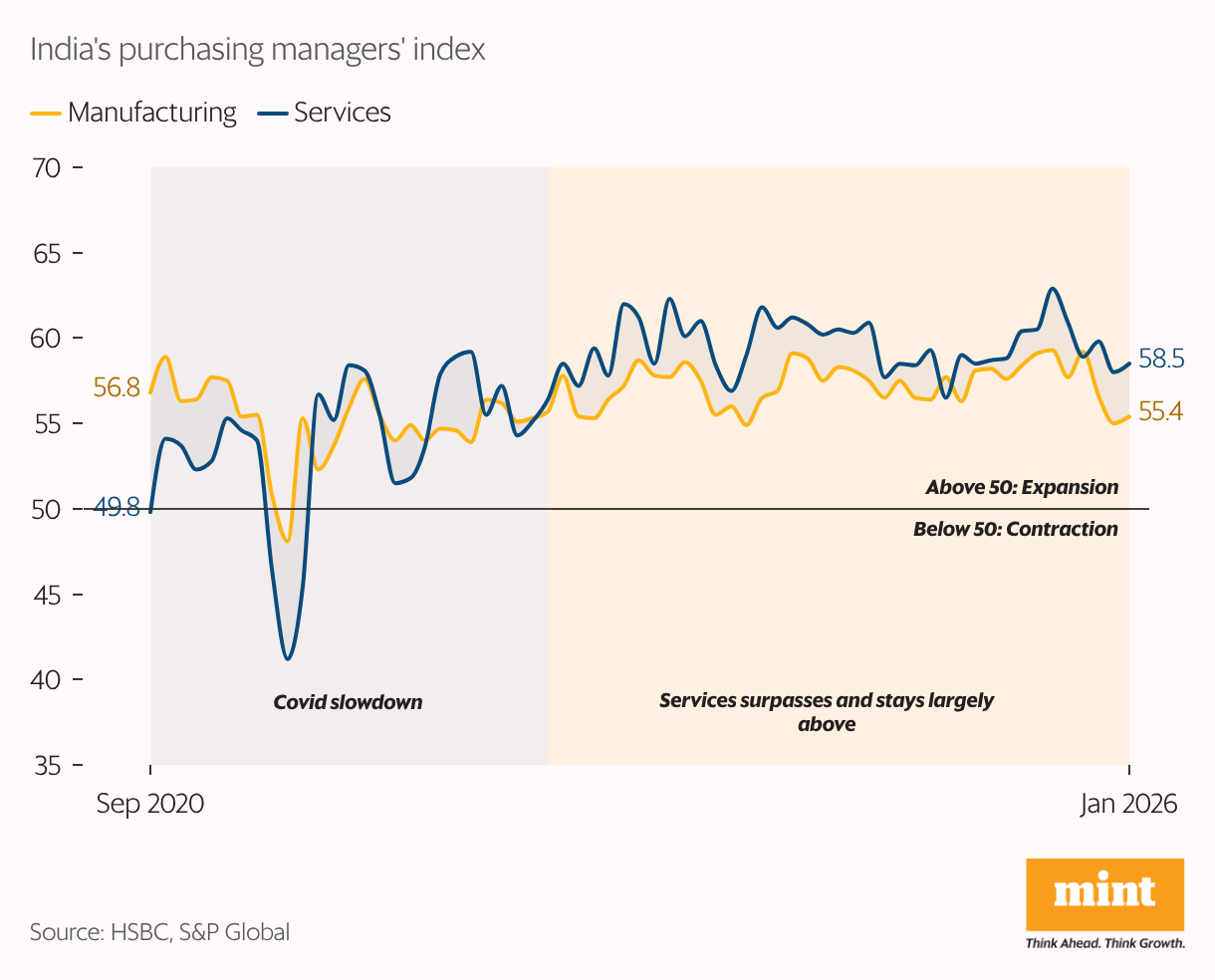
India’s services purchasing managers’ index (PMI) rebounded to 58.5 in January after slipping to an 11-month low of 58.0 in the previous month, primarily due to faster expansions in new business intakes and output.
Manufacturing PMI also saw an uptick to 55.4 from 55.0, recovering from the December 2025 slowdown. While monthly volatility has existed in both manufacturing and services PMI in recent years, services activity has clearly outpaced manufacturing.
This pattern has largely held since service activity overtook manufacturing in November 2022, following a recovery from the covid-led slowdown. Manufacturing has exceeded services only twice since then—both in 2025, in January and October.
Tax favours
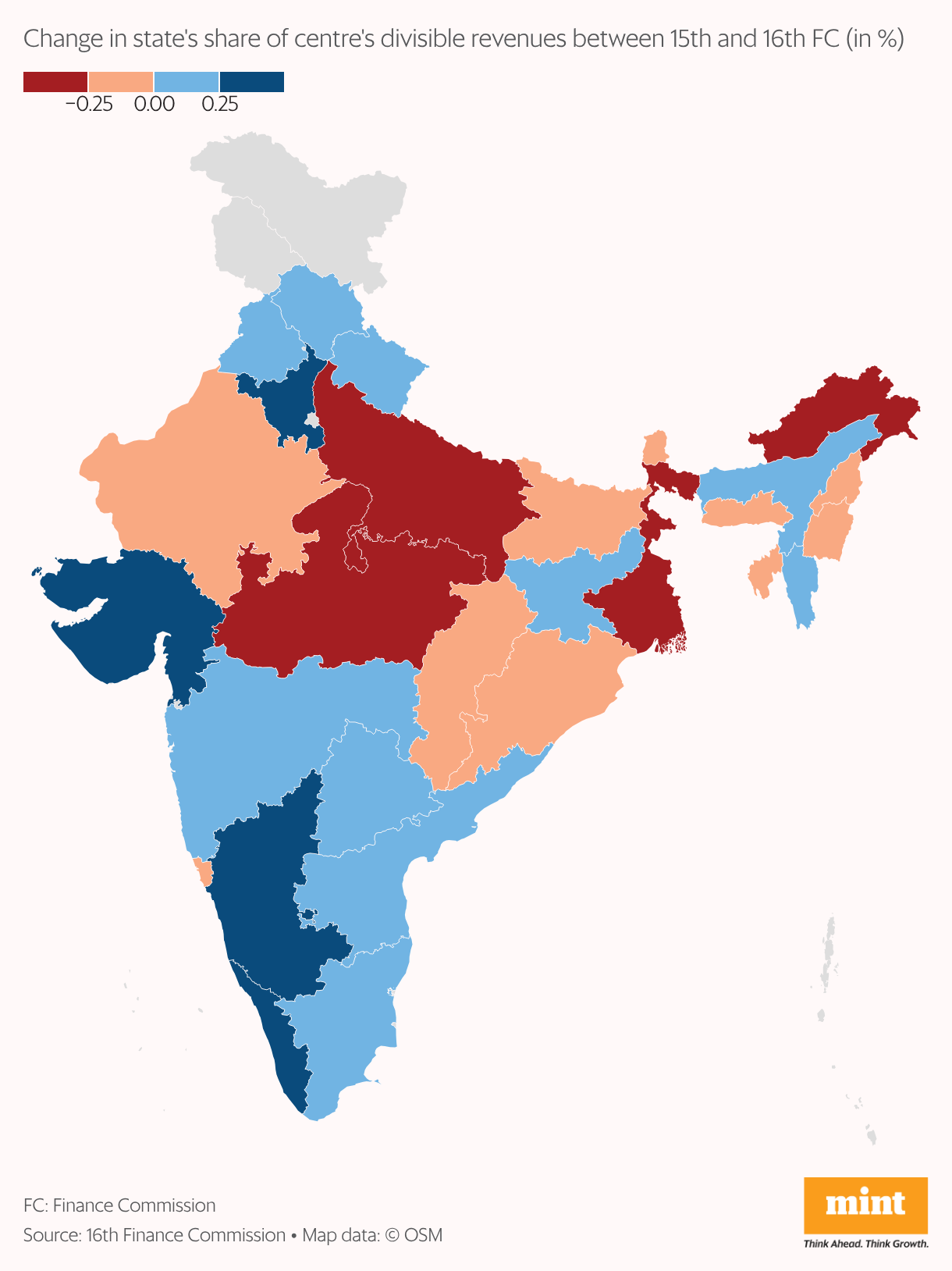
The 16th Finance Commission has brought some relief to richer, better-performing states, with their share in the Centre’s tax devolution rising after the introduction of a new criterion—states’ contribution to GDP.
Karnataka saw the sharpest increase, with its share rising from 3.6% under the 15th Finance Commission to 4.1% under the latest award. Other southern states, along with Maharashtra and Gujarat, also recorded gains, addressing their long-standing argument that fiscal transfers penalized economic success.
In contrast, some poorer states saw marginal declines. Uttar Pradesh’s share fell from 17.9% to 17.6%, while Bihar’s declined from 10.1% to 9.9%. Central taxes are devolved through two mechanisms: vertical devolution, which fixes the overall share of taxes to states—retained at 41% in this Finance Commission—and horizontal devolution, which determines how this share is distributed among states.
Startup inequality
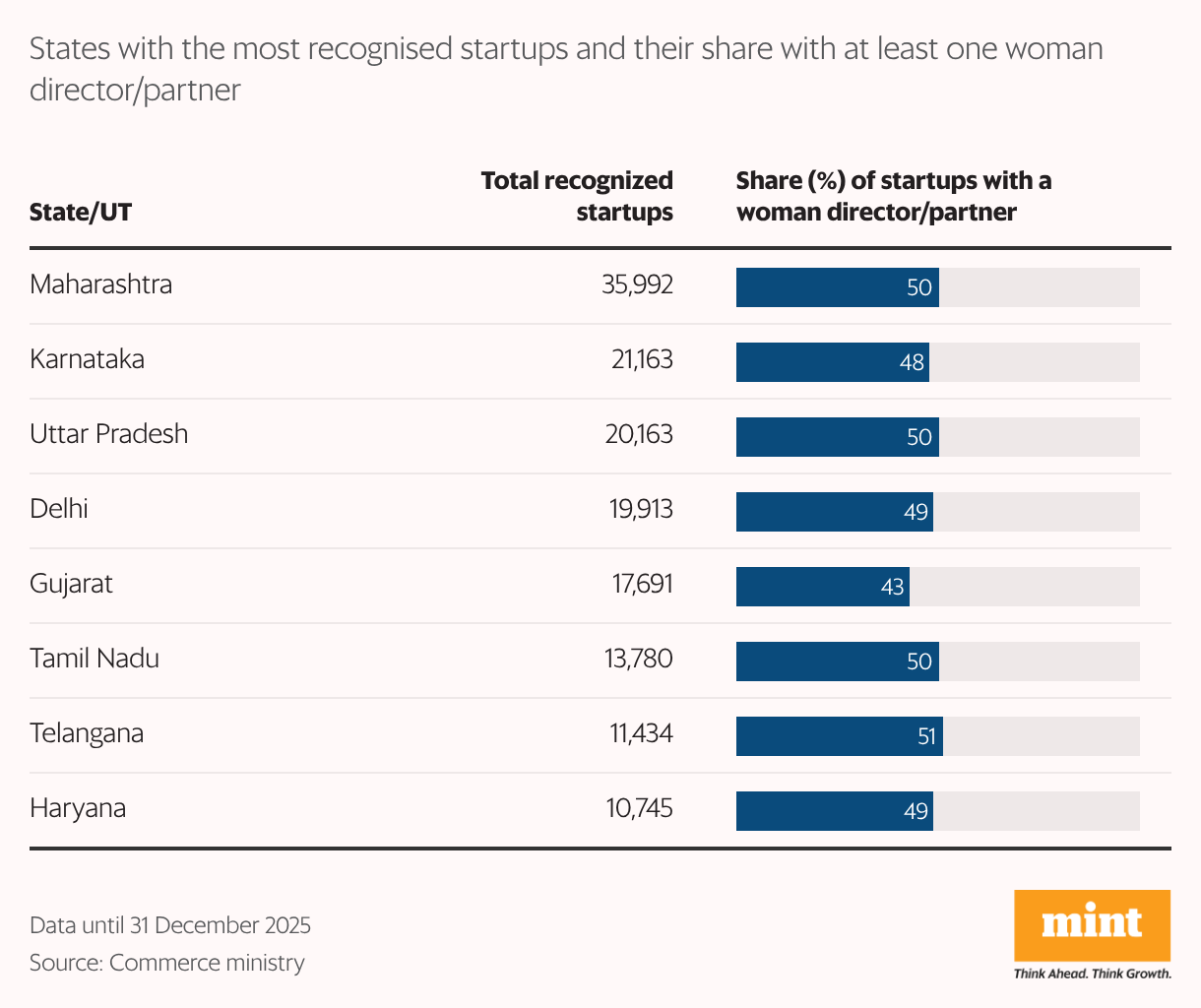
India’s startup ecosystem appears to lack women’s leadership, according to commerce ministry data tabled in the Lok Sabha on Tuesday. Less than half of over 200,000 recognised startups in India have at least one woman director or partner.
A similar pattern is seen across most states, where this share hovers around 50% or lower. Even in states with the highest number of startups, women hold a relatively small share of leadership roles.
For instance, Maharashtra, which has the largest number of startups, has only about 50% with a woman director or partner. Karnataka, with around 21,000 startups, has just 48%.
Despite featuring in the top 10, Gujarat has only about 43% of startups with at least one woman director or partner. This suggests that while India’s startup culture is expanding rapidly, gender diversity has yet to pick up.