Three years ago, that routine broke. Riding his bike into town, Reddy noticed a supermarket and slowed down. He hesitated, but curiosity and need got the better of him. He bought only a couple of items, but was hooked after that first visit.
The store is one of the 140 mostly franchisee-owned grocery outlets run by retail startup SuperK. All the stores are located in small urban centres in Rayalaseema, with the city of Kadapa at the core.
“I do all my grocery shopping at the SuperK store now. The variety and quality is very good, and there are always good offers,” says Reddy, a college dropout. He spends around ₹5,000 for his monthly essentials at SuperK.
Reddy’s shopping habits offer a glimpse into how consumption is increasingly playing out across India’s small towns and semi-urban markets. Consumers like him are powering a small but growing group of startups, such as SuperK, CityMall, Glamzy, Zaaroz, Navo and Rozana, which are attempting to solve retail for Bharat or non-metro India.
These startups, spread across categories as varied as grocery, beauty, fashion and hyperlocal delivery, have arrived at the same conclusion. India beyond the metros may finally be viable enough to support large-scale retail, but success will not come from replicating metro-oriented playbooks.
The new wave
The new business models these startups are creating have elements selectively borrowed from multiple playbooks, across e-commerce, traditional trade, modern retail and technology.
SuperK is building an organised, franchisee-led grocery chain in Rayalaseema, betting on membership pricing, disciplined expansion and tightly controlled private labels.
CityMall operates a value-led online grocery model across Uttar Pradesh, Haryana, West Bengal and Bihar, aggregating demand digitally while offering slower community partner-led fulfilment to keep costs low.
Glamzy runs company-owned beauty stores in tier-II and III cities in Karnataka, Kerala and Tamil Nadu, combining offline consultative-selling and online convenience buying. Zaaroz delivers food, groceries, medicines and daily essentials across small towns in Tamil Nadu through an app. Navo operates upstream, helping small-town fashion retailers in eastern Uttar Pradesh and Bihar source trending designs through a video-led wholesale platform.
Rozana goes deeper still, operating an assisted rural commerce model that combines peer partners, centralized warehousing and walk-in distribution stores across more than 22,000 villages in Uttar Pradesh and Haryana.
The Meesho lesson
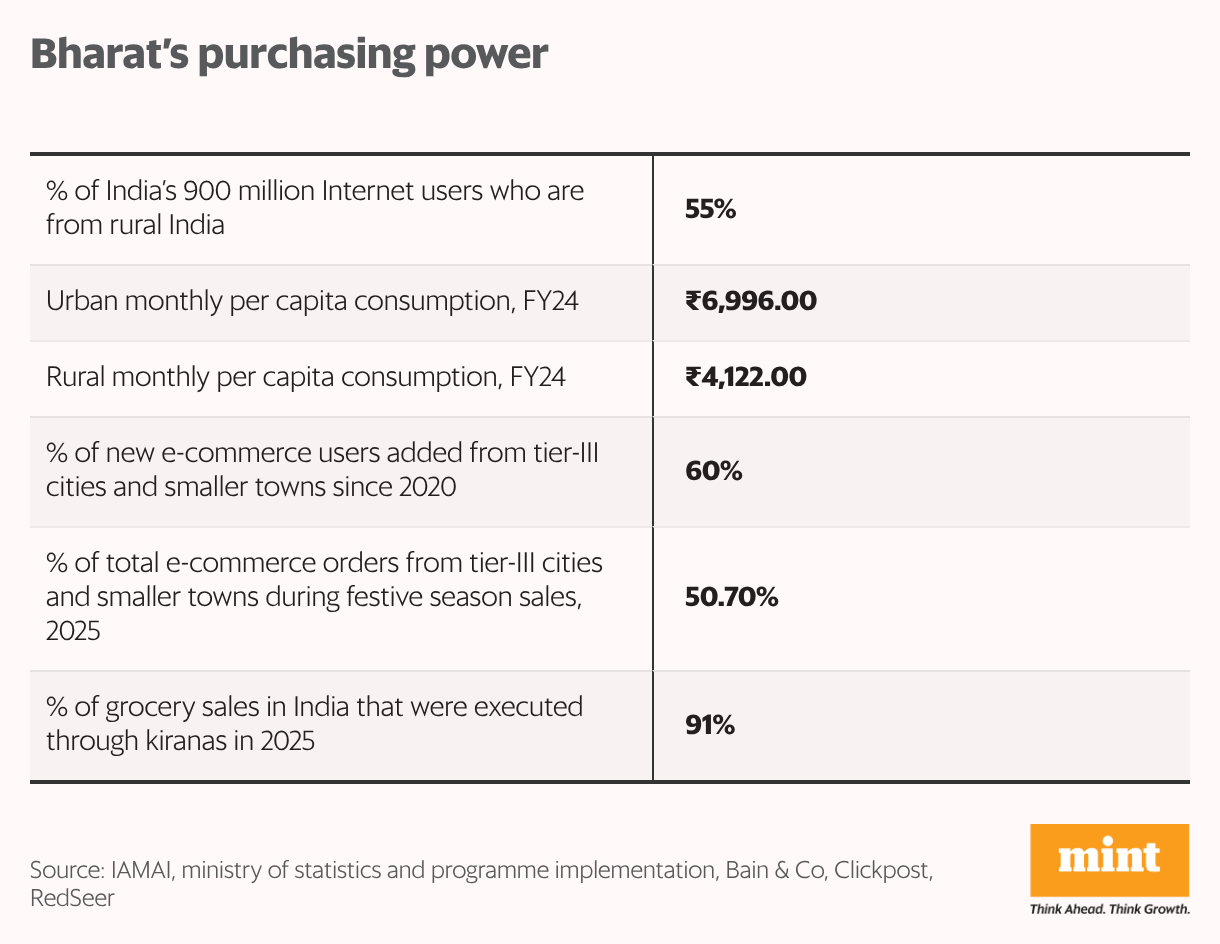
While metro India has seen rapid retail innovation from large-format stores to quick commerce, Bharat remains overwhelmingly a kirana market. Industry estimates put the number of kirana stores at 12 million to 15 million. Research firm RedSeer Strategy Consultants valued the kirana-led grocery market at $598 billion in 2025, accounting for 91% of India’s grocery sales.
“Rural demand has always existed. The problem was never demand, it was always the cost of reaching that demand,” says Kaushika Madhavan, chairman of consulting firm Kearney India. In many categories, he notes, close to 40% of consumption comes from non-urban India.
Over the years, several attempts were made to crack this market from ITC’s e-Choupal to Hindustan Unilever’s Project Shakti. “The ideas are right, but for different reasons, these models didn’t scale,” Madhavan says.
That has begun to change. A Bain and Company report shows that 60% of all new e-commerce users added since 2020 came from tier-III cities or beyond.
With general e-commerce now reaching deeper into India, the question is: can non-metro focused retail businesses carve a space for themselves? Ecommerce company Meesho has already answered that question.
Meesho focused early on non-metro users through small-ticket categories, cash-on-delivery, vernacular interfaces and social distribution. By FY25, Meesho’s operating revenue had crossed ₹9,000 crore. When it went public in December 2025 at a valuation of around $9 billion, it validated a larger idea: designing for small-town India, rather than waiting for it to resemble metros, could produce consumer businesses of meaningful scale. In the 12-month period ended September 2025, users for 205.8 million of its 234.2 million transactions came from non-metro cities and towns.
“I don’t think this is a winner-take-all market,” says Dipanjan Basu, partner at Fireside Ventures, an investor in rural retail platform Rozana. “It’s a market that can support multiple sustainable businesses. We will see different players coexist and build viable outcomes.”
Value before speed
While 10-minute deliveries are the differentiator in metro India, in small-town Bharat, value is king.
“Our average order value is low, typically around ₹500 per household,” says Angad Kikla, who co-founded CityMall in 2019. “While they don’t want to compromise on quality, they are okay to compromise on brand. Their preference is price before choice and convenience.”

View Full Image
To make the economics work, CityMall aggregates orders and fulfills them in batches through local community partners. Slower delivery keeps logistics costs manageable and prices lower. The company currently operates in around 60 tier-II and III cities, including Unnao, Barabanki, Gonda and Sultanpur. Its revenue increased from ₹346 crore in FY23 to ₹427 crore in FY24, but losses widened from ₹145 crore to ₹159 crore over the same period, according to data firm Tracxn.
SuperK’s value offering is membership, an idea central to the success of modern-day retailers such as Costco in the US. Customers pay a fee starting at ₹299 for a 10% cashback on every purchase. “This makes us cheaper than anyone that you can find in your neighborhood,” says Anil Thontepu, who co-founded the company in 2019.
For Zaaroz, which operates as an aggregator and delivery partner for restaurants, grocery stores, and pharmacies, value has to work for both sides of the marketplace. Founded in 2019, the company shifted to a subscription model in 2025 to make costs predictable for small-town merchants. Vendors pay ₹750 a month for fewer than 50 orders, ₹1,500 for up to 100 orders, and ₹3,000 for more than 100 orders.
Customers are charged a platform fee of ₹12, which the company retains, and a flat delivery fee of ₹12, which is passed on to the delivery partner after GST.
“There is transparency for the company, the vendor, the customer, and the delivery partner,” says chief executive Ram Prasath, who expects ₹75–100 crore in turnover and about ₹30 crore in revenue this year.“Because there is no commission, restaurants and merchants list their actual prices on the app.”
This, he adds, differentiates Zaaroz from national platforms such as Zomato and Swiggy.

View Full Image
Trust is human
If value is what draws customers in, trust is what keeps them coming back. In small towns, trust often equals a physical presence.
“Curiosity gets built online,” says Rahul Aggarwal, who co-founded Glamzy in 2021. The company runs 60 stores in small cities and towns across Karnataka, Tamil Nadu and Kerala and also offers an online platform. “But the consumer wants active guidance from a person they know and trust. That is very important in skincare. Colour cosmetics is a complete try-and-buy category.”
Mary Sophia, a 29-year-old Mysuru resident and a Glamzy regular, attests to this. “At Glamzy, I can ask questions, try out products and get guidance,” says Sophia, who purchases products of brands such as Plum, L’Oréal and Faces Canada at the Glamzy store.
Glamzy pivoted from a B2B to a B2C model in early 2025 and now operates 60 company-owned stores, with annualised revenue close to ₹30 crore. Its target is to reach 300 stores by the end of 2026.

View Full Image
For Rozana, physical touchpoints are an integral part of the business model. When it launched operations in 2021, it did not have an app. Orders were placed over the phone, and deliveries routed through local residents who offered their homes as drop points. Over time, these residents became what Rozana now calls ‘peer partners’.
Today, the company works with about 36,000 peer partners, over 80% of them women, who act as ordering points and delivery hubs. Rozana estimates it has paid more than ₹80 crore to these partners over the last four years.
As the model evolved, Rozana added app-based ordering and eventually converted its distribution centres into physical walk-in stores. More than 75 such stores are operational, with another 70 planned by April. Revenues in areas where stores opened rose by about 30%.
“People come in autos and buses from nearby villages and bring their families,” says co-founder Ankur Dahiya, who revealed that the company delivered goods worth ₹800 crore last year. “They get to see where their products come from. It builds trust.”

View Full Image
Ear to the ground
One of the least visible, yet most consequential, choices these companies made was go to where decision-making took place. Instead of operating Bharat-facing businesses entirely from metro offices, several founders chose to move closer to their core markets.
“You cannot understand this customer sitting in Bengaluru,” says SuperK’s Thontepu. In the retailer’s early years, the entire founding team, around 30 people, lived in Kadapa with their families for nearly three years. Even after moving to Bengaluru, SuperK maintains a guesthouse in Kadapa with founders and team members continuing to spend extended periods there.
“We have roamed extensively in all these towns, spoken to the customers, lived like them. That’s our edge,” he says.
Glamzy is headquartered in Mysuru, while Zaaroz is based in Tamil Nadu’s Chidambaram. One of the founders of Rozana, Adwait Vikram Singh, lives in a village near Rae Bareli.
“By being closer to your consumers, you hear problems early,” says Glamzy’s Aggarwal. “You don’t wait for them to show up in numbers.”
Private label edge
In retail, even in metros, private labels have been a key margin lever. In small-town markets, they serve a larger purpose.
At SuperK, private labels offer the option of significantly higher margins. But the company caps that upside. “We retain a margin of only around 5% to 10%, even though we can go up to 30%,” says Thontepu. While a one-litre branded detergent could be priced at around ₹200, its SuperK equivalent is priced at around ₹140. That visible gap drives trial and repeat purchases.
CityMall uses private labels to control pack sizes and price points that reflect how small-town consumers actually buy. During Diwali, the company saw strong demand for small packs of sweets such as gulab jamun, formats that were either unavailable or overpriced among established brands. In response, the company launched Sethi Sweets, which offers two-piece packs of gulab jamun and rasagullas for ₹29 per pack.
A different scale
Despite growing traction, the fact remains that grocery margins remain thin, logistics costs rise sharply once density breaks, and consumer loyalty is still fragile. What works in one district can fail in the next. This is why these companies are focused on growing cluster by cluster, aiming for density rather than spread.
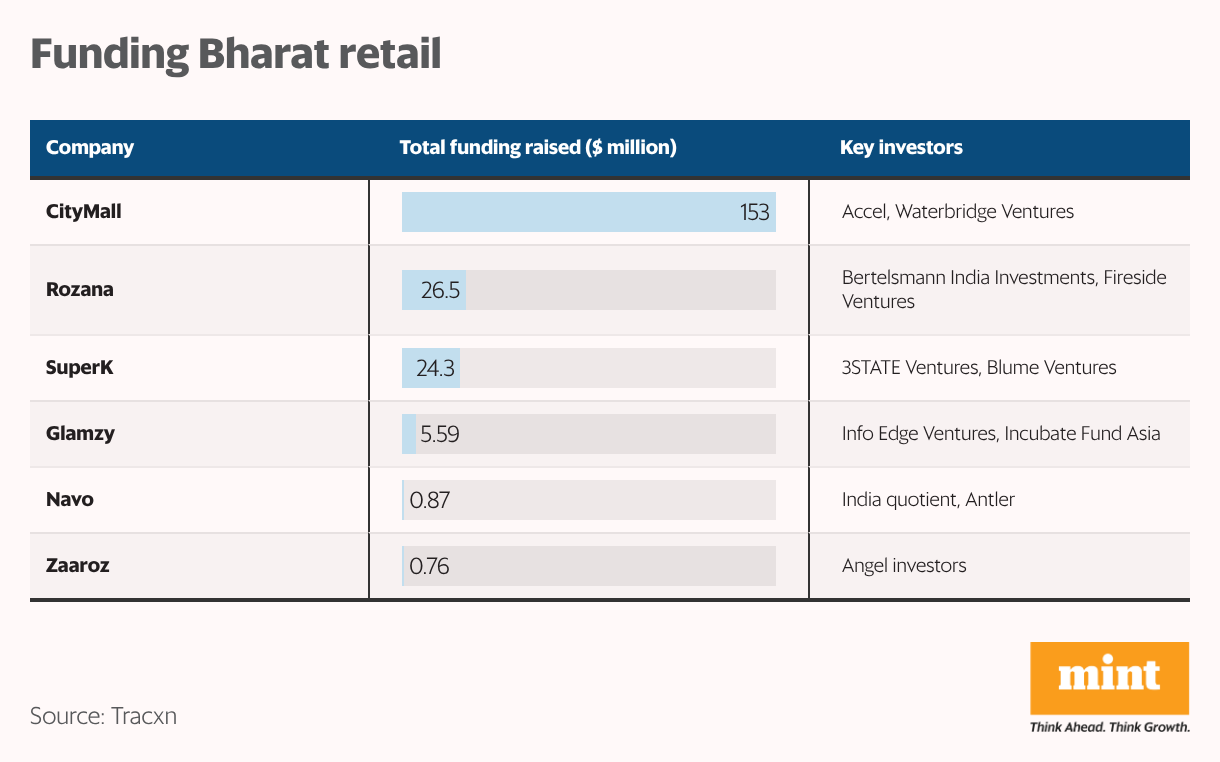
SuperK operates only in Rayalaseema. Thontepu argues the region alone is large enough to support a ₹3,000 crore grocery business. SuperK is currently at around ₹85 crore in revenue.
Navo, which supplies on-trend fashion, especially sarees, to retailers in eastern Uttar Pradesh and Bihar through its video-led app, treats geography as a core design input. “What works in one geography doesn’t automatically work in another,” says co-founder Suparn Goel. Navo’s technology platform identifies on-trend fashion products, sources them from Surat, and makes them available on its app immediately. The company, which launched in 2022, is targeting around ₹15 crore per month by Diwali this year. That growth, Goel says, will come from deepening its presence in specific regions, not spreading itself thin.
A different definition
As with any format, the unique value each of these business models create will be key to success.
Vikram Gawande, director of growth investments at Blume, an early investor in SuperK, says the challenge is one of endurance. “Startups in this space will have to answer how they facilitate small-town aspirations in a way that plays to their core strengths, and do so at low margins,” says Gawande. “That requires founders who are persistent and tenacious, and who keep finding ways to give more to the consumer.”
But the shift they represent is already visible. Retail is finally offering an experience that values the Bharat consumer’s comfort and needs.
“This is not a moment, it’s a phase. India is in a ‘present continuous’ of cracking non-urban consumption. The only question is how long it will take,” says Kearney India’s Madhavan.
Key Takeaways
- A Bain and Company report states that 60% of all new ecommerce users added since 2020 are from tier-III cities or beyond
- A few startups are leading retail innovation in small-town India, targeting rural consumers traditionally served by kirana stores and informal markets
- These startups have built hybrid models blending ecommerce, traditional trade, modern retail, and tech, focusing on value, pricing, partnerships, and local supply chains
- The potential is huge Non-metro India has huge untapped demand, with 91% of grocery sales from kiranas
- The challenge is one of endurance
- Despite growing traction, the fact remains that grocery margins remain thin, logistics costs rise sharply once density breaks, and consumer loyalty is still fragile